
July 14, 2026
How AI Scanning Changes the Way You Interact With Your Belongings
For decades, home inventory management has had one bottleneck: manual data entry.
You want to catalog your possessions. You take a photo. Then you sit down and type: item name, category, location, condition, notes. Five minutes per item. Most people quit before they start.
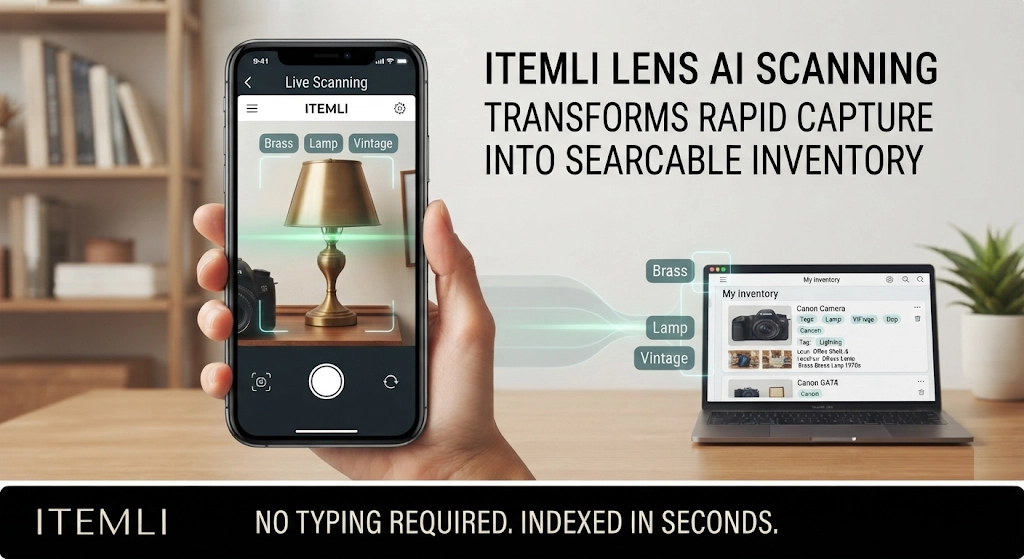
But what if pointing your phone at an item and tapping a button gave you a complete, searchable inventory entry. Automatically. Point your camera, confirm the details, and you're done. Zero manual entry required.
That's Itemli Lens.
Why Manual Entry Always Fails in the Long Run
"Home inventory" was treated as a project, something you'd tackle on a rainy weekend. But projects get delayed, and delays become abandonment.
The problem isn't laziness. It's that typing metadata for hundreds of items creates decision fatigue. Do you call it "Winter Coat" or "Outerwear"? Is the condition "Good" or "Like New"? By item 15, the friction outweighs the benefit, and most people quit.
With Itemli Lens, cataloging isn't a project anymore. It becomes something you do in the moment: when you bring home new shoes, when you move items to storage, when you reorganize. It fits into your actual behavior instead of asking you to change it.
How 10 Seconds Changes Everything
Here's the mechanism: point your phone at an item, tap "Capture", and the AI builds a complete entry. Name, category, condition, location - all auto-filled. Just review and confirm.
Ten seconds per item instead of five minutes. But the speed isn't just a convenience. It changes *when* and *why* people use the app.
At five minutes per item, you batch catalog quarterly, if at all. The inventory drifts out of sync with reality. At ten seconds, you catalog in the moment: when you bring home new shoes, when you move items to storage, when you reorganize a closet. The inventory stays current because staying current requires almost no effort.
This is why speed matters more than features. It's not just faster. It's a different habit.
What the AI Actually Does
Point your phone at a winter coat. Itemli Lens returns:
- Item type: Winter Coat
- Category: Clothing → Outerwear
- Condition: Like New
- Tags: seasonal, winter, storage
- Location: Bedroom Closet
Review for 2-3 seconds. Tap confirm if it's right. Correct specific fields if they're off. That's it.
When we were building Itemli Lens, we realized something: if the AI takes more than 2–3 seconds to tag an item, people mentally switch back to "this is a chore." So we prioritized sub-second auto-fill over adding more features. Speed is the feature.
The deeper benefit is consistency. When you manually type "Winter Clothes" for one item and "Outerwear" for another, your inventory becomes unsearchable. The AI ensures every winter coat is tagged identically, which means search actually works.
Finding Things Again
The feature that makes this actually useful isn't the capture speed. It's that the inventory remains queryable. When you've cataloged items with consistent categories and locations, you can actually *find* them.
Standing in a store wondering "Do I already own a drill?" Search Itemli. Find it instantly. Save yourself from repurchasing something you already own.
Most home inventory apps fail because they become data graveyards: hundreds of items entered manually, impossible to search because nobody was consistent about categories or locations. Itemli's model sidesteps this entirely by making consistency automatic.
The Workflow
Point, tap, review, confirm. Ten seconds from photograph to searchable inventory entry. Most of the time, the AI gets it right, and you move on. If something's off: category, location, condition - tap it and fix it in place.

Real-World Impact: When Rapid Cataloging Changes Behavior
Moving Day
You're packing boxes. Traditionally, you'd label them "Box 7" or "Kitchen Stuff" and hope you remember what's inside when unpacking arrives. Instead, capture the items as you pack. After a move, searching "where's my screwdriver?" tells you exactly which box it's in because you cataloged it in the moment.
Seasonal Storage
You're storing holiday decorations in the attic. Next year, you forget what's in there and buy new decorations anyway. The originals sit unused for years. With Itemli, you'd search "holiday decorations" and see what you already own, preventing unnecessary purchases and waste.
Reorganizing
You move items around in your closet or rearrange a room. Without cataloging those changes, your mental model of where things are drifts from reality. If you capture as you reorganize, your inventory stays synced with your actual space.
The Future of Inventory
Inventory software has been stuck in spreadsheet mode for decades. Type fields. Remember categories. Maintain consistency. Most apps get abandoned because the overhead isn't worth the benefit.
Itemli Lens is built on a different assumption: if cataloging is fast and frictionless, people will actually do it. Not quarterly. In the moment. As items arrive, move, or get stored.
The practical outcome is an inventory that stays current and searchable. You know what you own and where it is. Capture, confirm, and your inventory is indexed. That's the whole workflow.
Ready to transform how you interact with your belongings? Download Itemli and experience home inventory the way it should work: capture, confirm, done. Zero typing required.
Comments
Loading comments…