
July 19, 2026
How Itemli Helps You Declutter Without Emotional Overwhelm
You stand in front of a closet full of clothes you haven't worn in years. Each piece carries a memory: the dress from that party, the shirt from a trip you loved, the jeans that fit "perfectly" before life happened.
You tell yourself you'll wear them again. You can't throw them away. What if you need them? What if you regret it?
So you keep them. The closet stays full. You buy new clothes because you can't find anything to wear. The cycle continues.
This isn't laziness or a storage problem. It's emotional friction—the gap between knowing you should declutter and actually being able to let things go without guilt or paralysis.
Most decluttering advice says "let go," "be ruthless," "minimize." But decluttering isn't about willpower. It's a decision-making problem, amplified by emotional attachment and fear of making the wrong choice.
Why Decluttering Feels So Emotionally Hard
Psychologists call it "decision fatigue"—mental exhaustion from making too many difficult choices. Decluttering amplifies this in three ways:
1. Every Item Demands a Binary Choice
Keep or throw away. No nuance. No middle ground. This binary choice—without context or confidence—creates paralysis. By item #50, your brain is exhausted. Decisions get worse. You stop decluttering entirely.
2. Emotional Attachment Obscures Rationality
That sweater isn't just a sweater. It's connected to a memory, an identity, a version of yourself you might return to. Your brain says: "I paid $60 for this," "My mom gave me this," "I wore it once at that event."
These emotional anchors prevent objective evaluation. You can't simply ask "Do I use this?" because the answer involves memories, guilt, sunk costs, and hopes about the future.
3. Lack of Context Prevents Confident Decisions
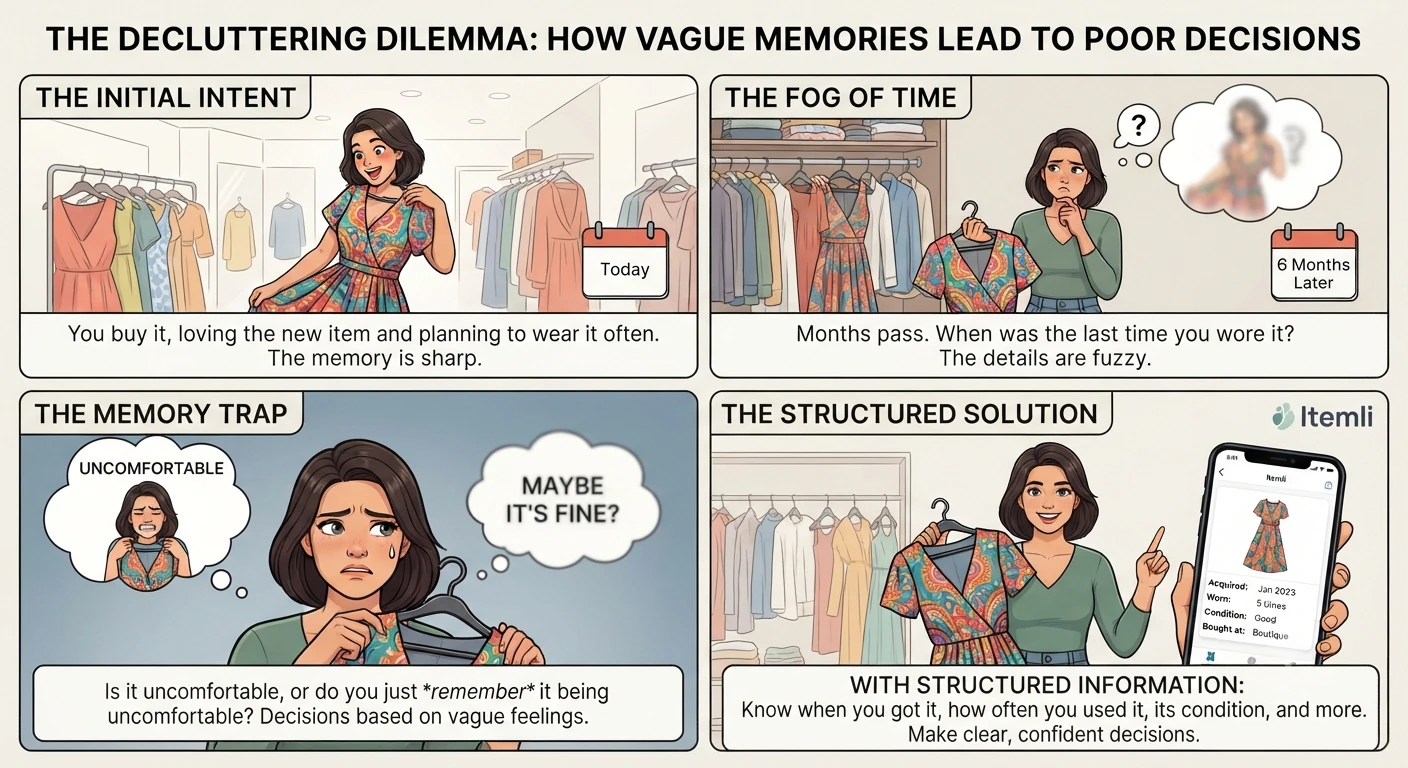
When you're holding an item, you know whether you use it. But months later, when you're ready to let it go, you've forgotten the details. Why did I buy this? When was the last time I wore it? Without structured information, you're making decisions based on vague feelings and imprecise memories.
How Structure Reduces Emotional Friction
The path forward isn't "be more ruthless" or "embrace minimalism." It's creating a system that removes emotional friction from the decision-making process. That system has four components:
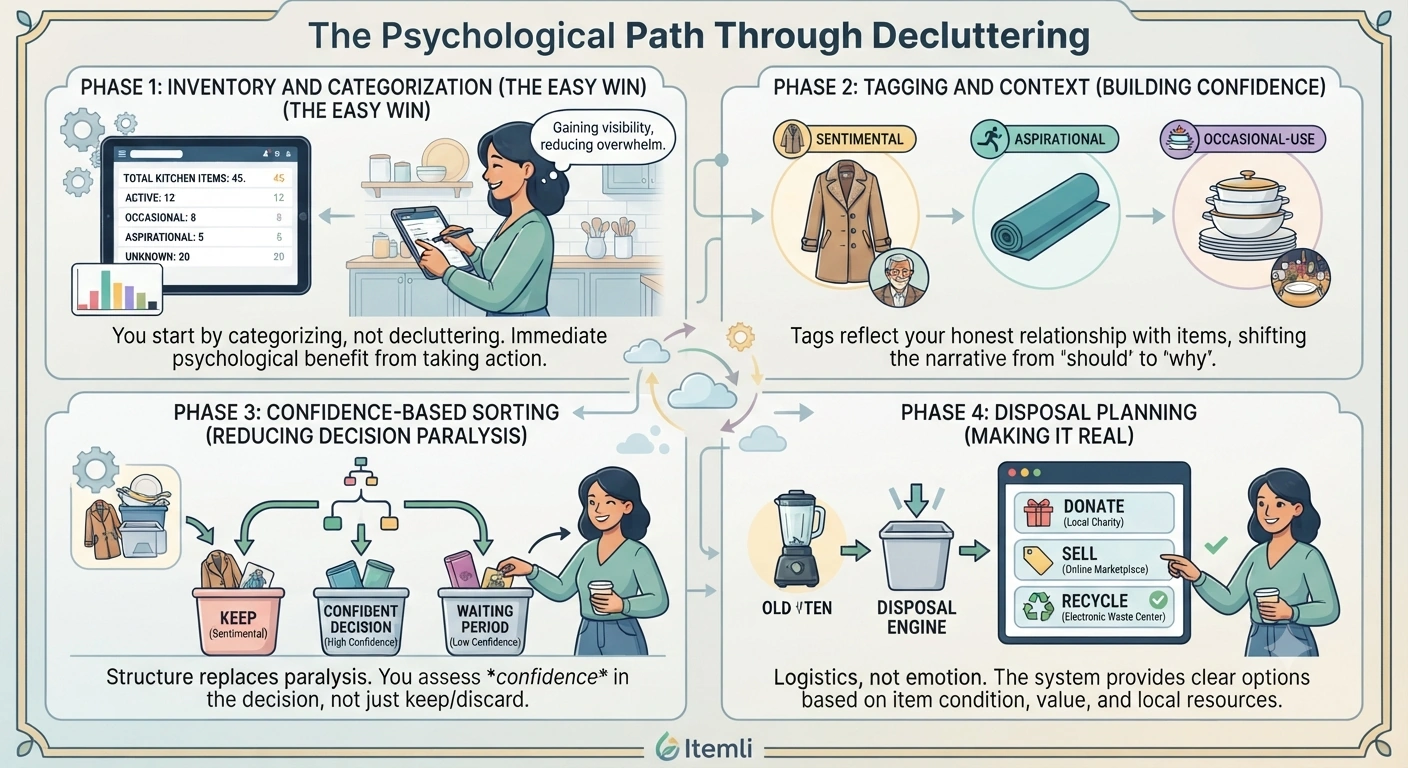
Phase 1: Categories, Making Decisions Smaller
Instead of "Should I keep everything in this house?" (paralyzing), ask "Should I keep everything in my 'Winter Clothes' category?" (manageable).
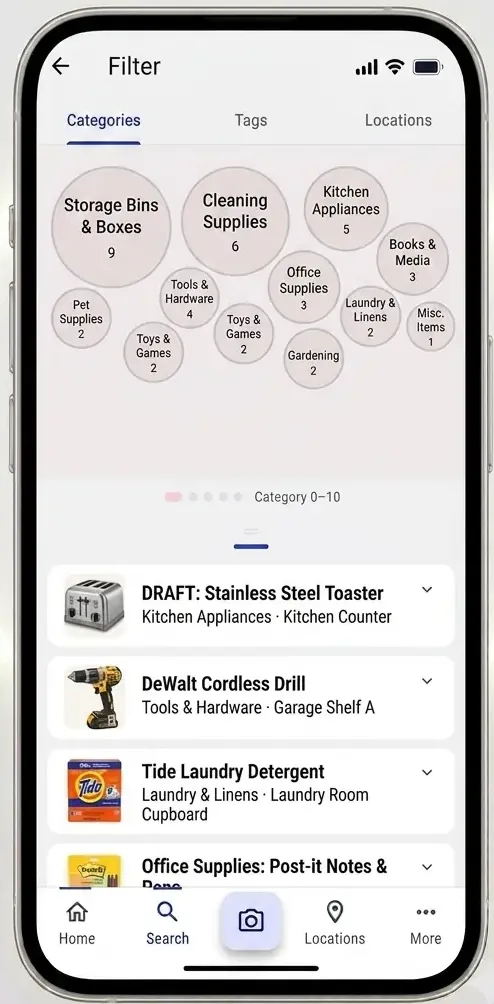
Categories break decluttering into psychological bite-sizes. You're not facing 1,000 items—you're working with 40 winter coats. Manageable. Your decision-making capacity holds up better, and patterns emerge naturally: "I have 7 power drills. Do I actually need seven?"
Categories also reduce shame. Instead of "Look at all this stuff" (overwhelming), it becomes "In my Kitchen category, these are the items I actually use" (actionable). Segmentation is emotionally protective.
Phase 2: Tags, Finding the Nuance
Tags let you move beyond the binary "Keep or Discard" and capture the real complexity:
- "Sentimental", Items connected to people or memories you want to preserve
- "Occasional-use", Things you use 2-3 times per year but genuinely need
- "Aspirational", Items for a version of yourself you're working toward
- "Broken-repairable", Items that need fixing before you decide their fate
- "Duplicate", Backup items you don't necessarily need multiple copies of
- "Gifted", Things people gave you that you want to honor even if you don't use
- "Seasonal", Items used only at specific times of year
- "Active-rotation", Things you use regularly
These tags create psychological permission structures. A sentimental item tagged "sentimental" isn't a failure—it's a legitimate category. You're creating visibility and intention around what you keep, not getting rid of everything.
Tags also let you aggregate decisions. Tag 15 items as "aspirational" and ask: "Am I realistically working toward these goals? Or keeping them out of guilt?" This connects individual decisions to larger patterns, reducing emotional weight.
Phase 3: Confidence-Based Sorting, Honoring Uncertainty
When building Itemli, we noticed something surprising: the moment people faced a binary "keep or throw away" choice, they got overwhelmed and closed the app. That paralysis was the real problem. So we built Confidence Scores to break that pattern.
Instead of forcing a binary decision, confidence-based sorting lets you rate it: "I'm 90% sure I want to keep this" versus "I'm 50% sure."
This honors the reality of decision-making. Many choices aren't certain, and pretending they are creates the paralysis. By surfacing your confidence level, you:
- Prioritize low-confidence items for second review instead of deciding immediately
- Batch similar decisions so you can make bulk choices
- Stop obsessing over high-confidence items: decide and move on
- Use uncertainty as a feature—uncertain items deserve a waiting period, not immediate disposal
Decluttering isn't about certainty. It's about making the best decision you can with incomplete information, then revising as you learn more. That's wisdom, not weakness.
Phase 4: The Disposal Engine, Giving Items a Compassionate Exit
Even after deciding to declutter, a new barrier appears: "How do I get rid of this? Will it end up in a landfill? Can I donate it?" Items sit in "donate piles" for months because execution feels overwhelming.
The Disposal Engine provides a guided path for each item:
- Condition-aware recommendations, Good condition? Suggest donation or resale. Damaged? Suggest recycling or composting.
- Local disposal options, Find nearby donation centers, recycling facilities, or resale platforms
- Batch disposal suggestions, Group similar items: "These 5 electronics go to e-waste"
- Resale assistance, For valuable items, guidance on whether Facebook Marketplace, eBay, Goodwill, or consignment makes sense
- Sentimental alternatives, Photograph before disposal, gift to someone who'd appreciate it, or keep a smaller representation
This removes the "black box" of getting rid of things. You're giving items an intentional, appropriate destination. That transforms the experience from "failure to keep my things" to "I'm responsibly stewarding this item's next chapter."
The Deeper Truth: Decluttering Is About Self-Compassion
Popular decluttering methods treat items as the problem. Get rid of everything. Be ruthless. Minimize. The message is clear: you have too much, and the solution is to own less.
But that ignores the real problem underneath: guilt. Guilt about money wasted on unused items. Guilt about keeping sentimental things when you're "supposed to" minimize. Guilt about accumulation itself. These methods don't address guilt—they amplify it.
Itemli's approach is different. It starts with acceptance: You have possessions. Many carry real emotional weight—memories, hopes, identity. Some items are mistakes. That's all okay. The system asks you to be honest about what you have and why, and make decisions based on that honesty, not on shame.
That changes everything. You're not "failing to minimize." You're "intentionally keeping the sentimental items that matter while clearing out duplicates and things you don't use." That's wisdom, not failure. That's self-knowledge, not weakness.
The Practical Impact: What Actually Changes
- Reduced decision fatigue, Decisions are batched and structured. "I'm confident about 80%, 15% need a waiting period, 5% are ambiguous." Progress without exhaustion.
- Lower emotional friction, Sentimental items aren't failures; they're categories. Aspirational items aren't guilt; they're tagged. Duplicates aren't shameful; they're visible patterns.
- Faster disposal execution, The Disposal Engine removes paralysis. Execution happens within days, not months.
- Permission to keep things, You keep items that matter to you without guilt, because you've made the decision consciously and documented why.
- Reduced re-accumulation, Understanding what you have and why means you're less likely to buy duplicates or accumulate unwanted items.
The Path Forward: Compassionate Decluttering
Decluttering doesn't require you to become someone you're not. It's about building visibility into what you have, making intentional decisions about what matters, and moving forward without guilt.
Categories make decisions manageable. Tags acknowledge the real reasons you keep things. Confidence-based sorting honors uncertainty. The Disposal Engine turns "I should get rid of this" into clear action.
Together, these transform decluttering from a guilt trip into an act of self-care. You deserve a home that reflects what you genuinely love, use, and need. Itemli helps you build that—with honesty instead of shame.
Ready to start? Download Itemli and begin building a home that truly reflects who you are—one intentional decision at a time.
Comments
Loading comments…