
July 18, 2026
The Inventory Problem No One Talks About: Forgotten Storage Spaces
There's a box in your attic. You're not entirely sure what's in it. Could be holiday decorations. Could be old textbooks. Could be something you decided not to keep five years ago. Your basement has shelves—lots of them, filled with things you can't quite locate when you need them.
When you actually need something, you have two options: spend 20 minutes rummaging through boxes in dim light, or just buy a new one. Most people choose the latter.
Your garage has become a storage facility—not by design, but by default. Every item that didn't fit anywhere else migrated there, where it now sits in the dark, invisible to your daily inventory awareness. This is the storage blind spot that most households never discuss.
It's not that your stuff is unorganized. It's that entire categories of your possessions have been relegated to "forgotten" status simply because they're out of sight and out of mind. And this has a direct, measurable cost.
The Geography of Forgotten Possessions
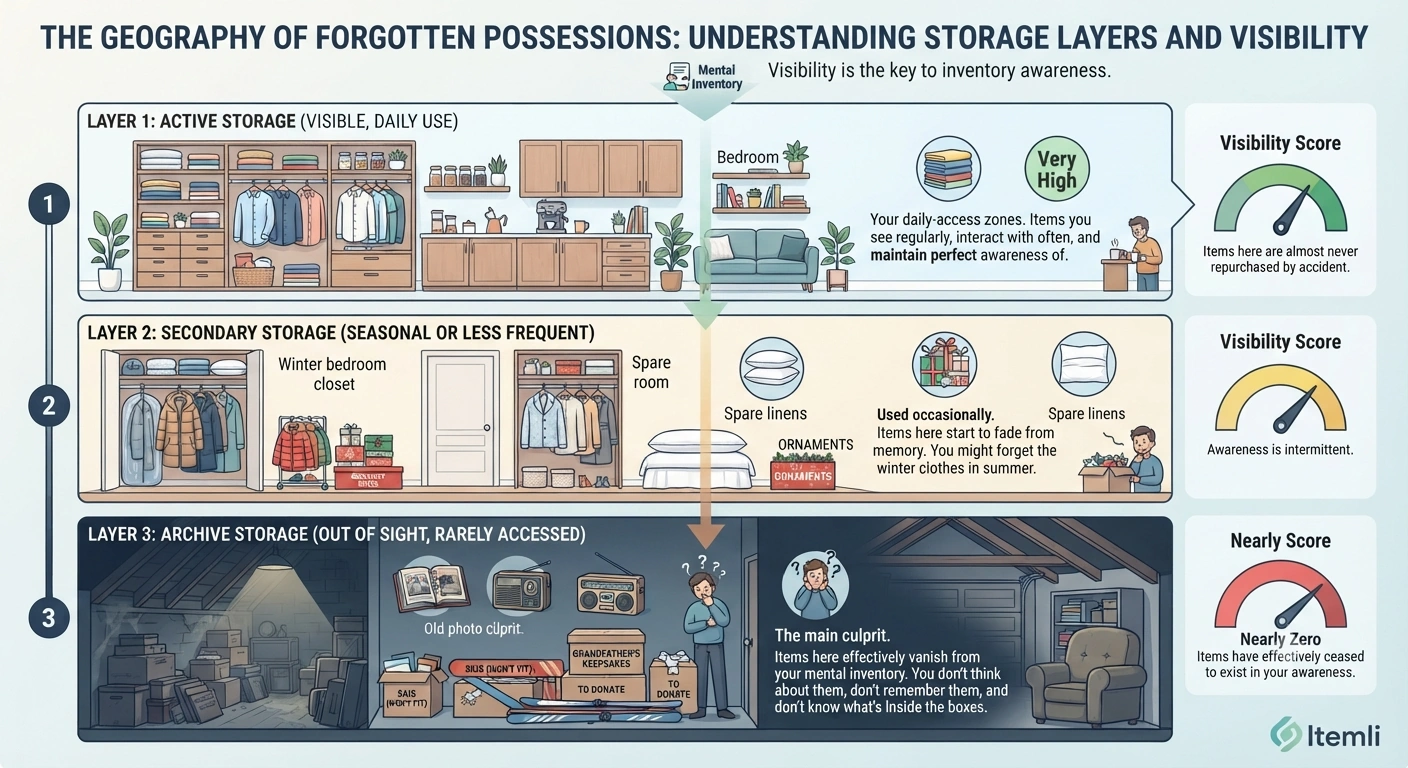
Every home has storage layers. Understanding them helps explain why visibility matters:
Layer 1: Active Storage (Visible, Daily Use)
Your bedroom closet, kitchen cabinets, living room shelves. These are items you see regularly, interact with often, and maintain awareness of.
Visibility score: Very high
Items in active storage are almost never repurchased because you know they're there.
Layer 2: Secondary Storage (Seasonal or Less Frequent)
Guest bedroom closets, spare room shelves, the back of your coat closet. Items used occasionally but not daily.
Visibility score: Medium
These items start to fade from memory. You might forget about the winter clothes stored in summer, or the decorations packed away 11 months a year.
Layer 3: Archive Storage (Out of Sight, Rarely Accessed)
This is where the real problem lives: attics, basements, garage corners, storage units, shed rafters.
Items end up here for reasons:
- Seasonal overflow: Holiday decorations, seasonal clothing, sports equipment for winter/summer only
- Sentimental or rarely used: Photo albums, keepsakes, hobby equipment you don't actively use
- Future intentions: "I might fix this someday," "I might use this eventually," "I might sell this"
- Too bulky for prime real estate: Large furniture, storage boxes, items that deserve space but aren't daily-access needs
- Procrastination storage: Items you meant to donate, return, or handle but just... stored instead
Visibility score: Nearly zero
Once items enter archive storage, they effectively vanish from your mental inventory. You don't think about them. You don't remember them. They've ceased to exist in your awareness.
The Paradox of Hidden Value
Here's the paradox that creates financial waste: your attic and basement might contain thousands of dollars in items you own but don't remember owning.
Research on home inventory suggests that the average household has:
- $2,000-5,000 in forgotten items stored away
- 20-30% of stored items that could be sold, donated, or returned if they were discoverable
- 15-20% duplication rates in archived storage—people buy new items because forgotten items are inaccessible
The tragedy isn't just the forgotten value—it's the active financial behavior it triggers. When someone can't find their winter decorations, they buy new ones. When they forget they have four sleeping bags in the garage, they buy a fifth. When they can't locate their backup drill, they purchase another.
Archive storage isn't just a static repository. It's an active drain on your finances because its invisibility creates repurchasing behavior.
Why Archive Storage Breaks Traditional Inventory Systems
Most home inventory approaches fail catastrophically at archive storage:
Mental Tracking Doesn't Scale
You might remember "I have some decorations in the attic," but do you remember which specific items? Are they holiday lights? Ornaments? Both? Is there a second box of backup decorations? When was the last time you checked?
Your brain didn't evolve to maintain precise inventory of items it can't see. Archive storage exceeds human short-term and long-term memory capacity.
Physical Labels Are Friction
A box labeled "Holiday Decorations" helps you avoid opening random boxes. But it doesn't help you when you're shopping and wonder: "Do I already own white Christmas lights?" You'd need to climb to the attic, open the box, check contents, and then make a decision. In practice, most people don't do this. They just buy new lights.
Spreadsheets Require Manual Updating
A spreadsheet listing archive storage contents requires someone to:
- Actually create the spreadsheet
- Accurately document items in storage
- Update it when items are moved, removed, or added
- Check it when making purchase decisions
This workflow is so friction-heavy that almost nobody maintains it. Spreadsheets work for active inventory (current pantry items) but fail for archive storage (things you barely think about).
How Visibility Transforms Archive Storage
The solution isn't better labeling or spreadsheets. It's making archive storage searchable from wherever you are—your phone in a store, your computer when planning, your kitchen when cooking.
Search: From Blind Spot to Instant Access
Imagine you're shopping for winter boots. You're about to check out when you remember: "Wait, do I have boots in storage?"
Instead of:
- Driving home
- Climbing to the attic
- Opening boxes
- Searching through contents
- Discovering you actually do have three pairs
You pull out your phone and search "boots." Within two seconds, you see photos and locations of all boots in your home—including those stored in the attic. Decision made. Money saved.
QR Codes: Physical-to-Digital Bridge
QR codes solve a critical gap: they connect physical storage locations to digital information. When designing Itemli's QR system, we realized the friction point wasn't knowing what's in storage—it was the cost of checking. Opening a dusty tote in a dimly lit attic just to verify contents is high friction. Scanning a QR code from two feet away? Zero friction.
Here's what changes:
- Label your storage box with a QR code that links to an itemized inventory of contents
- In the attic, garage, or basement: Point your phone at the QR code and instantly see what's in that box
- When making purchase decisions: Search your inventory. Results show both what you have and which storage location contains it
- When cleaning out: Use QR codes to quickly identify what you no longer need and can donate or sell
QR codes eliminate the gap between "I know I stored this somewhere" and "I have no idea where." They make physical storage queryable.
Categories: Mental Models for Storage
Organizing archive storage by category (Seasonal, Hobby Equipment, Furniture, Keepsakes, Tools) creates a retrieval system that matches how you think about items.
Someone who needs Christmas decorations doesn't search "storage"—they search "Seasonal: Holiday" and instantly find all seasonal items, including those in archive storage.
Categories also surface forgotten value. Browsing your "Hobby Equipment" category might remind you: "Oh, I have roller skates! And a tennis racket! And three guitars!" Suddenly, forgotten items become rediscovered treasures rather than invisible waste.
The Real Cost of Archive Invisibility
Let's quantify what happens when your stored items become invisible:
Direct Repurchasing
- Can't find winter boots → Buy new boots: $150
- Forget about holiday decorations in attic → Buy new ones: $200
- Don't remember camping equipment in garage → Buy new sleeping bag: $120
- Unaware of tool collection in basement → Buy new drill: $80
Annual repurchasing from archive invisibility: $550+
Opportunity Cost of Forgotten Value
You have items stored that could be:
- Sold for cash: That guitar, skis, or furniture gathering dust could generate $500-2,000
- Donated for tax benefits: Items you could write off but don't because you forget they exist
- Given away to friends: You could solve someone else's need from your archive, but nobody knows what you have
Annual value recovery opportunity: $200-500
Storage Space Waste
If you rent a storage unit or maintain excess attic/basement space because it's filled with forgotten and redundant items, you're paying for:
- Items you repurchased (duplicates taking up 10-15% of storage)
- Items you no longer need but can't identify for removal
- Inefficient use of storage because you can't optimize without knowing what's there
Annual storage waste: $100-300
Total Annual Cost of Archive Invisibility
$850-1,100 per household per year
This is conservative. For households with significant archive storage (multiple storage units, large basements, extensive attics), the cost can exceed $2,000 annually.
Beyond the Numbers: What Archive Invisibility Actually Costs
The $850-1,100 annual waste is real, but there's a hidden cost that spreadsheets don't capture: invisibility creates decision paralysis. Every purchase becomes uncertain ("Should I buy this boot, or do I have boots in storage?"). This uncertainty drives wasteful buying, hoarding dynamics (keeping items "just in case"), and lost utility—your own possessions become unusable because they're inaccessible.
Visibility transforms this. When you can search your archive, items stop being forgotten drains and start being useful assets. Your quality of life improves because your own stuff actually works for you, not against you.
The Transformation: From Storage Blind Spot to Searchable Inventory
When archive storage becomes searchable, everything changes. Forgotten storage becomes an asset. Purchasing decisions shift from guesswork to certainty. Repurchasing stops because you actually know what you own. And the items you once forgot about? They either return to active use, get sold for cash, or get donated meaningfully—instead of sitting in darkness.
The shift is simple: from invisible accumulation to intentional curation. Your archive stops being a financial drain and becomes what it should be: a curated collection you can actually use.
Starting with Archive Visibility
If archive storage is your blind spot, start here:
- Take inventory of what's in storage: Go through major storage locations (attic, basement, garage, shed) and photograph/document key items
- Use categories that match your mental model: Seasonal, Hobby, Furniture, Keepsakes, Tools, etc.
- Tag items with location: "Attic-Box-3", "Basement-Shelf-North", "Garage-Corner" help you find things physically
- Use search before buying: When considering a purchase, search your inventory first. Build the habit of verification before acquisition
- Set QR codes on storage boxes: Link physical locations to digital inventory for quick reference when in storage areas
The goal isn't perfection. It's making your stored items discoverable enough that they influence purchasing decisions and storage optimization.
Archive storage doesn't have to be a black hole. With visibility, it becomes what it should be: a curated collection of items you intentionally keep and can efficiently access when needed.
Ready to transform your storage blind spots into searchable inventory? Download Itemli on Google Play and start cataloging what you've forgotten you own.
Comments
Loading comments…