
July 10, 2026
The Hidden Cost of Disorganization: How Itemli Saves You Money
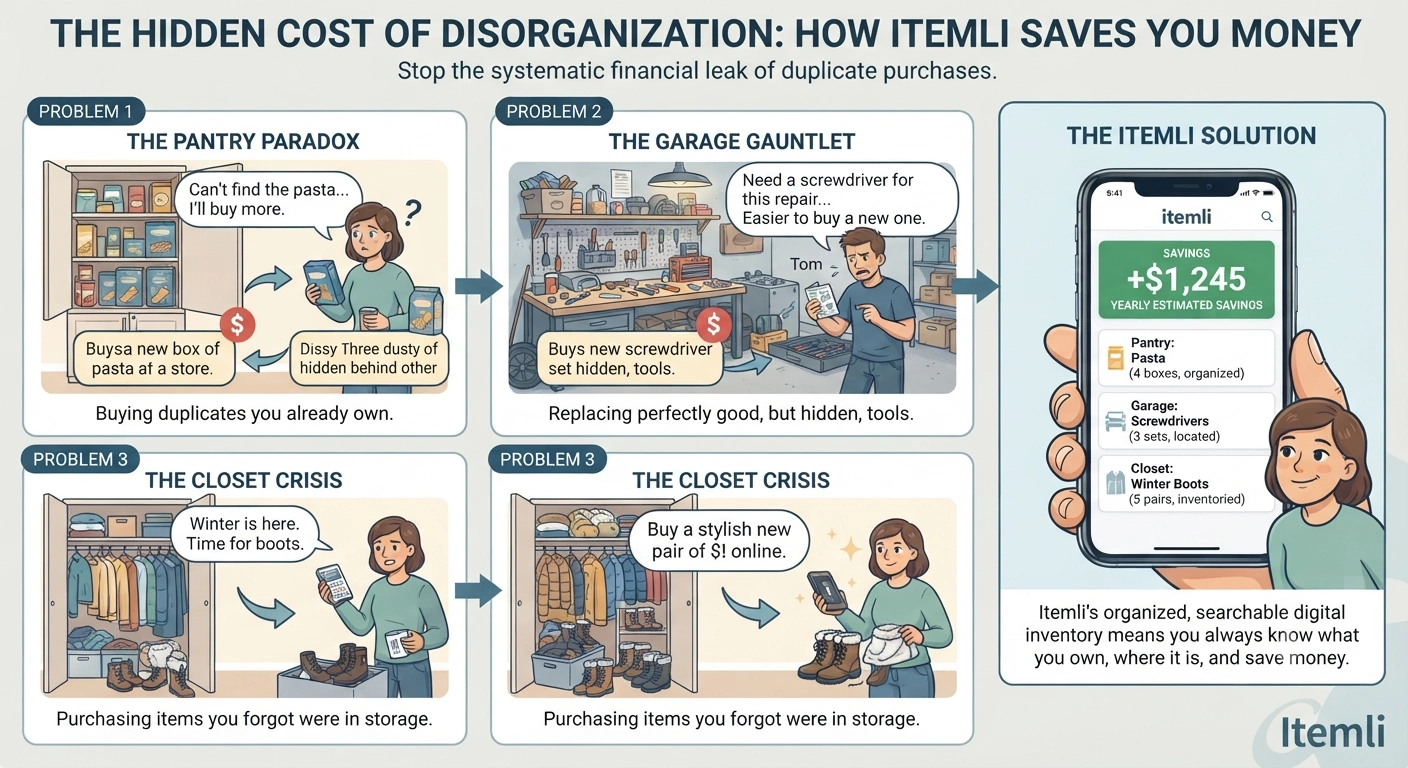
You walk into your pantry and can't find the pasta. So you buy more. Later, you discover three boxes in the back of the cabinet.
You need a screwdriver for a quick repair. Instead of searching through your garage for one, you buy a new one. Two days later, you find two others you already owned.
You're shopping for winter boots and forget that you have four pairs already buried in closet storage. So you buy a fifth.
These aren't one-off incidents. They're a systematic financial leak in most households-and they add up to thousands of dollars per year in wasted spending, duplicated purchases, and forgotten assets gathering dust in storage spaces.
This is the hidden cost of disorganization. And unlike dramatic expenses you can see and control, these losses happen quietly, one forgotten item at a time.
The Financial Math: What Disorganization Actually Costs
Studies from the American Psychological Association and the National Association of Professional Organizers paint a sobering picture:
- Average duplicate purchases per household annually: 12-15 items
- Average household spending on duplicate/forgotten items: $500–$1,500/year
- Percentage of people who can't find items and repurchase: 67%
- Space wasted on duplicates and forgotten items: 15-20% of storage capacity
It doesn't feel like much in the moment-a duplicate jar of spices, an extra hammer, another box of lightbulbs. But across a year, these micro-leaks compound into real money. For most households, that's $500–$1,500 annually in spending that visibility would have prevented entirely.
These aren't theoretical numbers. They reflect a documented behavior pattern: when people lose visibility of their possessions, they systematically repurchase what they've forgotten.
The Three Mechanisms of Financial Waste
1. Duplicate Purchases: The Most Common Leak
The single largest category of wasted spending comes from buying items you already own but can't locate or remember.
Picture this: It's Tuesday night, you're making dinner. You reach for soy sauce and can't find it. You're sure you bought it recently, but it's not in the front of the pantry where you expect it. Rather than dig through three shelves, you run to the store and grab a new bottle. Get home, start cooking-and there it is. Behind the salad dressings. Now you own two bottles of soy sauce you didn't intend to buy. This pattern repeats across your kitchen: olive oil you forgot you had, two jars of the same pasta sauce, three containers of cumin. Over a year, these invisible duplicates add up to $150–300 in wasted food spending.
The psychology is simple: if you can't instantly verify ownership, your brain defaults to "I probably don't have it"-and buying a replacement feels safer than searching. This happens everywhere. The drill in the garage buried under boxes. The black work shirt still in dry cleaning that you forgot about. The pack of USB-C cables in a desk drawer under old tax documents.
Each purchase individually seems insignificant. But stack up 12-15 of these moments per year, and you're looking at $400–600 in duplicates you never intended to buy.
2. Forgotten Storage: The Invisible Money Pit
Beyond duplicates, there's a deeper category of waste: money spent on items that exist but are forgotten in boxes, closets, and storage units.
November rolls around and you think about holiday decorations. You vaguely remember having some boxes somewhere-but where? Were they in the attic or the garage? What's actually in them? Can't remember. So you do what feels reasonable: you buy new decorations. A modest $200 investment. Next year, same story. The old boxes are still there, but you've already bought the replacement set. Year three, you've now spent $600 on decorations for a house that already owns $200 worth you can't find.
The same pattern repeats across seasonal clothing (winter coats you forgot you had), hobby equipment (rollerblades in a storage tub), garage tools (a perfectly good power drill buried under old bikes), and furniture (that end table that "disappeared" to the spare room and you forgot existed). Each category feels manageable in isolation. But when invisible spending across five categories adds $200-400 per year, it becomes real money.
3. Unused Capacity: The Silent Storage Tax
The third mechanism is less obvious but equally costly: paying for storage space that's filled with forgotten or redundant items.
If you rent a storage unit or maintain a full garage because you can't tell what's actually in there, you're paying for:
- Duplicate items taking up 15-20% of the space
- Forgotten items you could donate or sell
- Items you no longer need but can't quickly identify for disposal
A storage unit costing $100-150/month for 12 months = $1,200-1,800/year. If 20% of that unit contains duplicates or forgotten items, you're paying $240-360 annually just to store waste.
Similarly, a cluttered garage that could be parking space, a workshop, or a guest bedroom-but instead houses forgotten and redundant items-is costing you in lost utility value.
How Poor Visibility Enables Waste
The root cause of all three mechanisms is the same: lack of visibility and searchability.
When you can't quickly answer "Do I own this?"-because items are scattered across multiple locations, stored in unmarked boxes, or simply too numerous to mentally track-you default to the assumption that you don't own it. This creates a psychological and behavioral pattern of repurchasing.
Consider the traditional methods people use to manage home inventory:
- Mental tracking: "I think I have black shirts in my closet." (Unreliable, forgets items in storage)
- Physical labels: "Box #7" labeling system that requires you to physically open boxes to search
- Spreadsheets: Manual entry systems that nobody maintains consistently
- Nothing: The majority of households rely on no system at all
All of these approaches share a critical limitation: they don't provide instant, searchable access to information about what you own. So they fail in the moment of decision-when you're in a store deciding whether to buy something.
How Itemli's Features Prevent Financial Waste
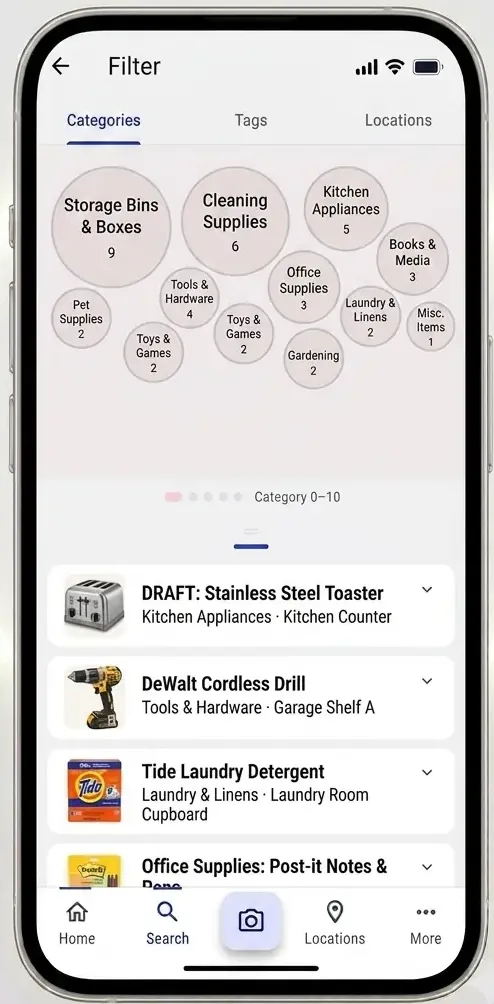
Search: Instant Verification Before Purchase
When we built Itemli's search, we obsessed over one thing: speed. Because there's a critical moment in every purchasing decision-standing in a store aisle, thinking "Do I already own this?"-and you have maybe 10 seconds before the friction of checking your phone makes you just buy the new one.
If your inventory search takes 30 seconds to load, 15 more seconds to navigate, and then you still can't find what you're looking for? You'll buy the drill. But if you can search "drill" and see your existing one-with photos, condition, location-in under 3 seconds? That changes the decision. You don't buy it. Money saved.
That's the entire design philosophy behind Itemli's search: make verification faster than the friction of buying a replacement.
Tags: Semantic Searchability at Any Level
Tags allow you to organize beyond rigid hierarchies. Items tagged with "holiday", "Christmas", "decoration", and "storage-attic" become findable through multiple search paths. Someone looking for "where did I put the Christmas lights?" can search "Christmas" and instantly find all related items, regardless of location hierarchy.
This solves the "forgotten storage" problem. Seasonal items are never truly forgotten-they're always findable through a quick search.
Categories: Reducing Decision Friction
Smart categorization (Tools, Kitchen, Bedroom, Seasonal, etc.) creates a mental model of your possessions that matches how you naturally think about them. When you need a screwdriver, you can browse the "Tools" category instead of having no system at all.
Categories also surface forgotten items. Someone browsing their "Sports" category might suddenly remember: "Oh right, I have roller skates!" This prevents the need to repurchase later.
The Financial Impact: A Concrete Example
Let's model how Itemli translates to real financial savings:
Scenario: A family of 4 with annual spending patterns
Let's model this against real household behavior:
- Kitchen staples duplicates prevented: 4–6 purchases × $20–30 = $80–180/year
- Seasonal/clothing duplicates prevented: 2–3 purchases × $40–60 = $80–180/year
- Tools and miscellaneous: 2–3 purchases × $25–50 = $50–150/year
- Subtotal from direct duplicate prevention: $210–510/year
But the compounding effect runs deeper. When you can actually see what you own, you use those items more-which means you don't feel the phantom need for replacements. That easily adds another $200–400/year in prevented "I thought I needed this" purchases. If you ever had a storage unit or garage space taken up by forgotten items, knowing exactly what's there could save you $100–300/year in unnecessary storage costs alone.
Realistic annual financial benefit per household: $500–$1,300/year-with higher savings if you've been paying for storage or buying seasonal items repeatedly.
This is not including the value of time saved searching for items, the reduced decision fatigue, or the ability to confidently make household purchases-all real but harder to quantify in dollars.
Beyond Money: The Ripple Effects of Better Organization
Financial waste is measurable, which is why we've focused on it here. But the benefits of visibility extend into behavioral and psychological territory:
- Reduced impulse spending: When you have to verify "Do I own this?" before buying, impulse purchases decrease. The friction of checking your inventory creates a moment of reflection.
- More confident purchasing decisions: You buy with certainty instead of guess work. When you know you already own item X, you're free to invest in item Y instead.
- Increased enjoyment of existing possessions: Forgotten items rediscovered are like getting free new things. Someone who finds their roller skates or tennis racket through Itemli suddenly has entertainment they forgot they owned.
- Reduced environmental impact: Fewer purchases means less production, packaging, and shipping waste. Duplicate purchases represent pure environmental waste.
The hidden cost of disorganization is real, measurable, and substantial. But it's also preventable. The pattern is universal: without visibility, people spend money replacing things they already own. With it, that waste simply doesn't happen.
Visibility doesn't just feel better-it saves money. Itemli transforms scattered possessions into a searchable, tagged, categorized inventory that answers the question "Do I own this?" instantly. And that answer prevents waste before it happens.
Ready to reclaim thousands in annual spending? Download Itemli on Google Play today and stop funding your own forgetfulness.
Comments
Loading comments…