
July 20, 2026
The Invisible Inventory: Why Most Homes Don't Know What They Own
Open your attic. What's actually up there?
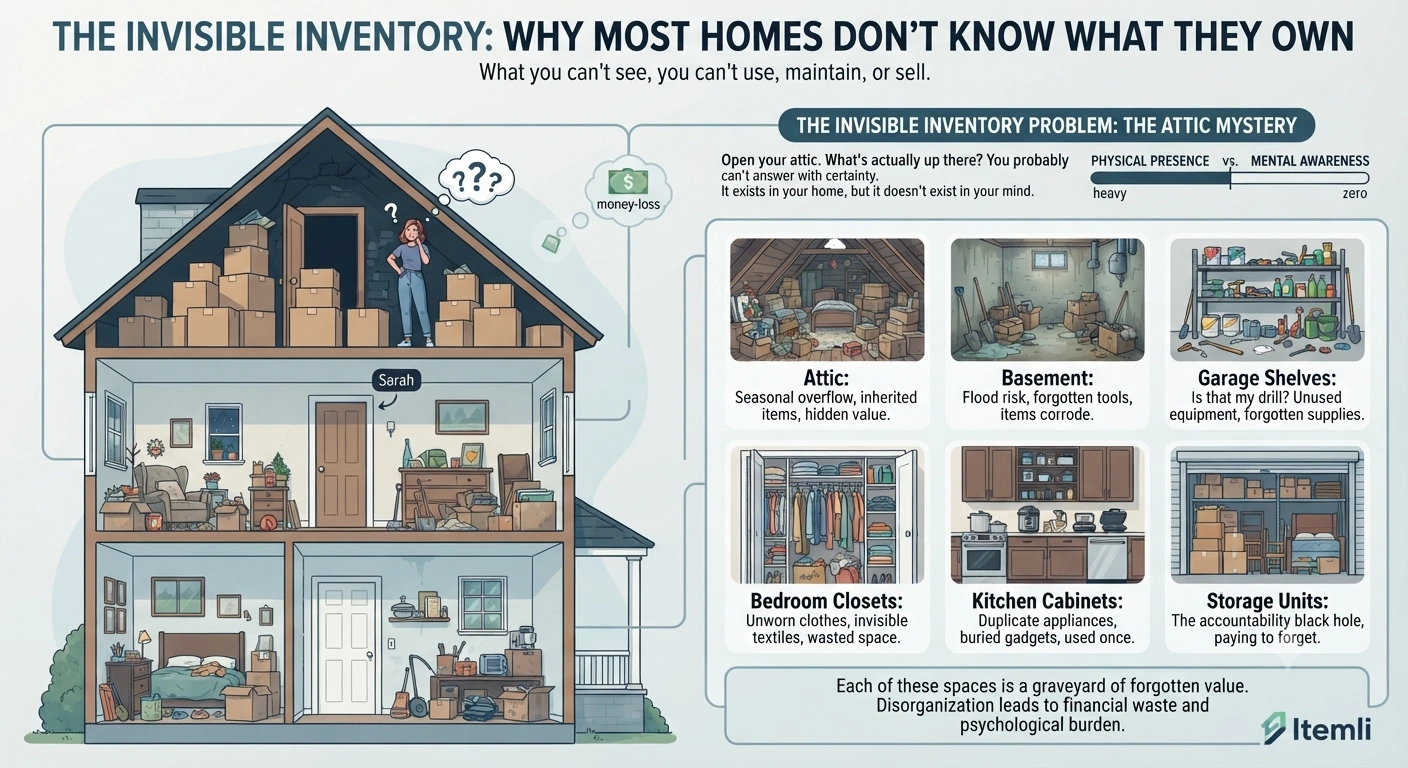
You probably can't answer with certainty. Most people can't. They know there's storage. They know there are boxes. But the actual contents? That's a mystery. It exists in your home, but it doesn't exist in your mind.
This is the invisible inventory problem, and it's far more expensive and psychologically draining than it seems.
The Blind Spots We All Have
Every home has them. The spaces where things go to disappear:
- Attics: Seasonal decorations, old furniture, inherited items no one sorted through. You know something's there. You don't know what.
- Basements: Flood risk, forgotten utility storage, tools nobody remembers owning. Conditions decay, items corrode, and you discover damage six months too late.
- Garage shelves: Half-empty paint cans, automotive supplies, gardening equipment. You're pretty sure there's a drill somewhere. Is it your drill or your neighbor's?
- Bedroom closets: Clothes from five years ago. Are they worth keeping or have they become invisible textiles taking up space?
- Kitchen cabinets: Duplicate appliances. Gadgets purchased with enthusiasm, used once, buried. You own a spiralizer. You probably didn't remember that yesterday.
- Storage units: The ultimate accountability black hole. Boxes entered and never audited. You pay monthly to forget about them.
Each of these spaces is a graveyard of forgotten value. Not because the items are worthless—many aren't. But because what you can't see, you can't use, can't maintain, and can't sell.
The Hidden Cost of Not Knowing
The invisible inventory costs money in ways that compound silently:
Duplicate purchases. You're at Target. You see a power drill on sale. You think, "I've been meaning to get one of those." You buy it. You get home, go to your garage, and there it is—the original drill, purchased three years ago, still charged. You just spent $50 to own the same tool twice.
Multiply this across a year: duplicate kitchen gadgets, overlapping clothing, redundant tools, forgotten electronics. Most families lose $500–$1,500 annually on repurchased items already gathering dust somewhere in their home.
Deterioration and waste. Things stored out of sight don't stay preserved. Seasonal clothing mildews in humid basements. Paint dries in garage cans. Electronics corrode. Furniture warps. You're not storing value; you're hosting slow decay. By the time you rediscover something, it's often no longer usable, and you're forced to throw it away—both financially and environmentally wasteful.
The space tax. Storage units cost $50–$150+ per month. Your attic and basement are free in rent but expensive in opportunity cost. That square footage could be used for something you actually access. Instead, it's rented out to forgotten items at the cost of clutter, stress, and the psychological weight of unseen disorganization.
Mental load. Every item you can't account for creates background anxiety. You know something's there. You don't know what. This unresolved uncertainty burns cognitive energy—not enough to consciously think about, but enough to create low-level stress. Your mind is running a search for items it can't find, and that search never completes.
Why Memory Alone Fails
You might think the solution is simple: remember what's in storage. But human memory isn't designed to catalog your possessions.
Memory works through retrieval—you remember things when you need them or when triggered by association. A storage box in the attic provides neither trigger. You don't interact with it. You don't see it daily. It exists in a cognitive dead zone.
Even people with excellent memory systems fail at this. You might remember "there's a box of winter decorations," but you won't remember:
- Which box (if there are multiple)
- Which specific decorations are inside
- Whether the lights still work
- If there's a missing component that breaks the set
- Whether a storage condition issue has degraded what's inside
Traditional solutions—sticky notes on boxes, handwritten labels, spreadsheets—fail because they require maintenance. A label fades or peels. A spreadsheet goes out of date when items move. Handwritten notes become illegible. The system breaks down because it requires discipline at scale, and discipline decays.
The Real Problem: Invisible Items Aren't Managed
Here's the core insight: invisible items stop being part of your active inventory. Psychologically, they're no longer yours. They're not stolen, but they're not accessible. They exist in a liminal state—owned but unavailable.
This is why you buy duplicates. When you need something, you search your active, visible spaces. The stored version doesn't factor into your decision-making. It's practically invisible.
This is why things deteriorate without notice. You can't maintain what you don't see. Moisture accumulates. Dust settles. Vermin move in. You don't know any of this is happening until it's too late.
This is why storage units become financial sinkholes. You stop evaluating what's worth keeping because you don't see it. You just keep paying the monthly fee out of habit and vague guilt about throwing things away.
What Digital Indexing Restores
The solution isn't better memory. It's making the invisible visible.
When you photograph items as you store them—capture the contents, the location, the date stored—you create a digital index. Suddenly, the invisible inventory becomes queryable. When we built Itemli, our core realization was this: if cataloging feels like work, people won't do it. The friction of traditional inventory systems—typing metadata, maintaining consistency, remembering to update—guarantees failure at scale. We designed Itemli around a different premise: what if capturing an entire storage area took seconds, not hours? Our AI-powered vision system turns a photograph into a complete, indexed entry automatically. No typing. No friction. Just point, photograph, and your storage becomes instantly searchable.
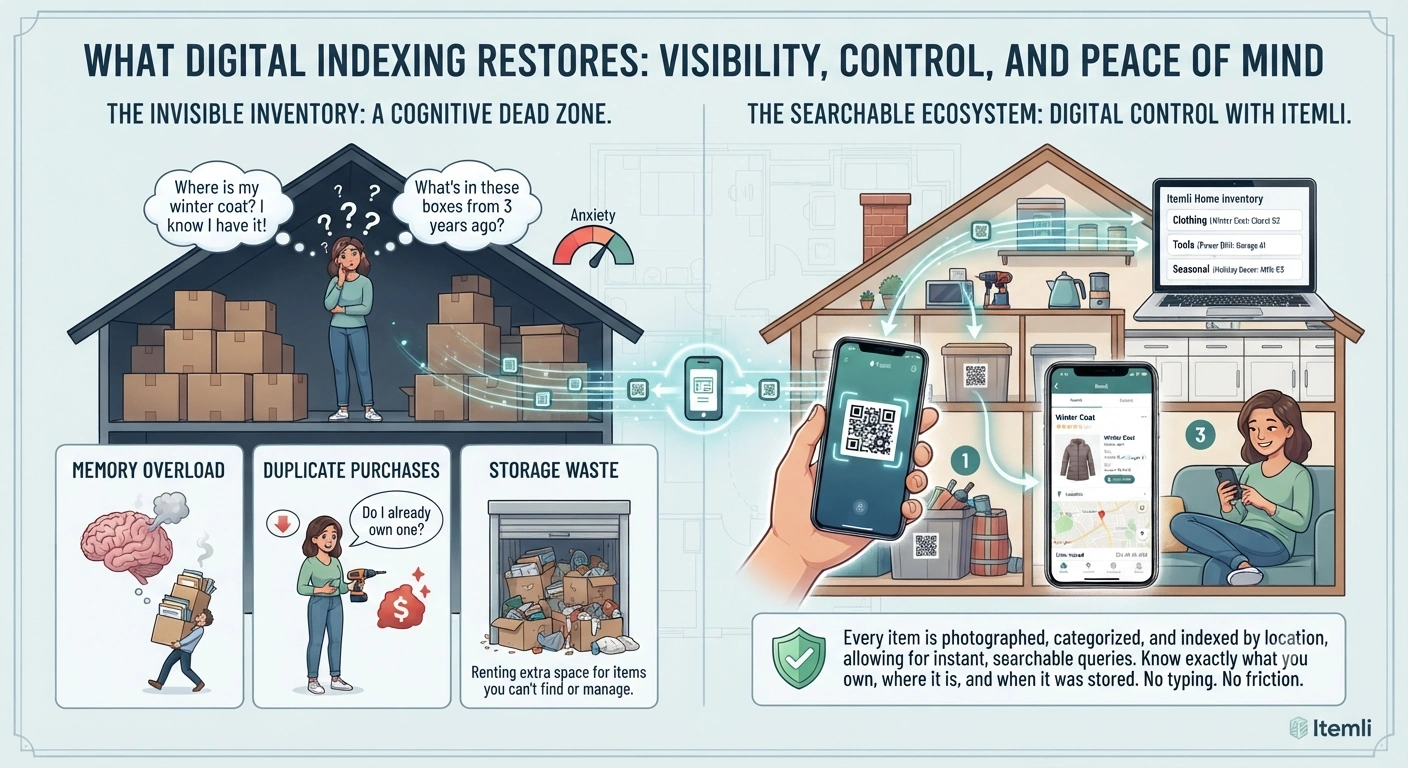
Standing in Target considering a power drill? Search your inventory. "Drill" returns one result: location (Garage, Shelf 3), condition (Good), date added (March 2023). Decision made. You don't buy it.
Moving into seasonal storage? Photograph each item as you pack. Tag it "seasonal," "winter," "storage." Come next December, search "holiday decorations." You get a complete visual index of what's stored where. You don't buy duplicates. You don't forget what you own.
Concerned about water damage in the basement? A photo index gives you a baseline. If you need to check on stored items, you can verify their condition against the photo. You catch problems early instead of discovering damage when it's catastrophic.
The attic, basement, and garage stop being mystery zones. They become indexable, searchable parts of your household asset registry. Every item is visible again—not physically, but digitally. And visibility changes behavior.
The Psychological Shift
There's something profound that happens when you photograph and catalog what you own: you stop acquiring unconsciously.
When your possessions are invisible, purchases feel like free additions. You already have everything you need (somewhere—you just don't know where), so buying more feels like adding to an unlimited collection. Storage is infinite in your mind because it's not indexed.
But when you can search your inventory and see that you own three winter jackets, four pasta pots, and six power tools—most still unused—the psychology shifts. Buying a seventh tool isn't adding value. It's just increasing the invisible inventory.
An indexed home creates intentionality. You know what you own. You know what you're actually using. You make different purchasing decisions because you have information.
From Blind Spots to Actionable Assets
The invisible inventory isn't a storage problem. It's a visibility problem.
Most homes don't lack storage. They lack indexed, accessible, searchable visibility into that storage. Your belongings are scattered across a dozen spaces, each unmapped and unrecorded. They might as well not exist. They cost you money through duplicates and deterioration. They cost you peace of mind through invisible clutter.
Itemli transforms this by making every item visible again. Photograph what's in storage. Tag it with location, category, and condition. Now your attic, basement, and garage are no longer mysteries. They're part of your indexed household ecosystem. You know what's there. You can find it. You can maintain it. You can make informed decisions about keeping it or letting it go.
When the invisible becomes visible, everything changes. Duplicate purchases stop. Deterioration gets caught early. Clutter becomes actionable. Your storage transforms from a cost center into part of a managed, searchable, intentional home.
Ready to reclaim your invisible inventory? Download Itemli and transform your hidden storage into visible, searchable assets. From attic to basement to garage—see what you actually own.
Comments
Loading comments…