
July 22, 2026
The Myth of 'I'll Remember Where I Put It'
You're standing in your bedroom looking for that one cable. You know you have it. You definitely remember putting it somewhere. "It's definitely in the junk drawer," you think. You open the junk drawer. No cable. You check the other junk drawer (yes, you have multiple). Still no cable. You search three more drawers before giving up and buying a new one.
Two weeks later, you find the original cable. It was in a mug on your nightstand the whole time.
This isn't a character flaw. This is how human memory actually works.
The "I'll Remember" Lie We Tell Ourselves
Everyone has said it:
- "I'll remember where I put this."
- "I know where that is."
- "It's in the obvious place. I won't forget."
- "I'll just put it here temporarily."
And then... you don't. Not because you're forgetful. Not because you're disorganized. But because your brain wasn't designed to be a filing system.
Your brain is fantastic at:
- Pattern recognition: Spotting the tiger in the tall grass
- Emotional processing: Remembering that one embarrassing thing you said in 2008
- Navigation: Finding your way home from unfamiliar places
- Social memory: Remembering what your friend told you about their life
Your brain is terrible at:
- Spatial cataloging: "In which of six drawers did I leave my scissors?"
- Indexing: "Which closet has winter boots? Upper shelf or lower?"
- Precise recall: "Did I leave my keys on the kitchen counter or the entryway table?"
- Maintaining accuracy over time: "Wait, did I move that to the garage last month?"
This is because human memory isn't a database. It's a pattern-completion engine designed for survival, not precise record-keeping.
Why We're All Convinced We'll Remember
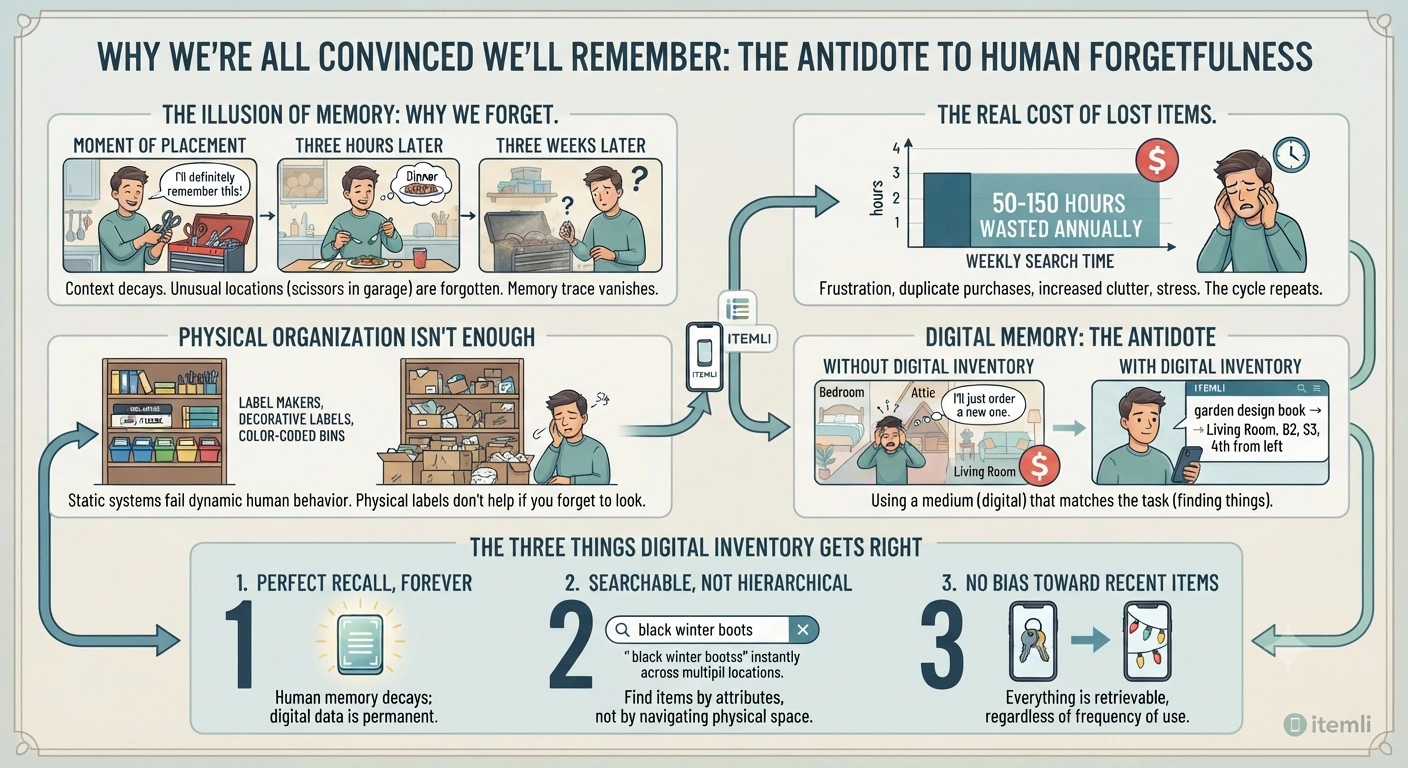
There's a psychological phenomenon called the illusion of memory. At the moment you place something somewhere, the memory feels crystal clear. You're in the moment. You see where it goes. You think: "I'll definitely remember this. It's obvious."
Then life happens. Three hours later, you're thinking about something else. Three days later, that storage location has become part of the background of your home—invisible. After three weeks, you've completely forgotten not just where the item is, but that you ever made that decision. This isn't a character flaw—it's cognitive science.
Context matters. You remember items in their typical location (kitchen scissors in the kitchen), but forget them in unusual spots (kitchen scissors in the garage). Your brain evolved to track things in expected places, not random storage decisions. Memory also decays over time. The first 30 minutes are crystal clear. After 24 hours? Vague. After a week? Mostly gone. And when you have five similar items—phone chargers scattered around your home—they interfere with each other. Your brain can't reliably distinguish between them.
The worst part is the encoding problem: if you didn't actively think "I'm putting this here," your brain never recorded the location in the first place. You just put something down without conscious attention, and it leaves no memory trace whatsoever. The "I'll remember" promise is made by someone who is fully present and aware. But a week later, you're operating on autopilot—a completely different cognitive state—with no access to that original decision.
The Real Cost of Lost Items
Searching for a single misplaced item takes an average of 15-45 minutes of your time. If this happens twice a week (and for most people, it does), that's:
- 1-3 hours per week lost to searching
- 50-150 hours per year wasted
- Thousands of dollars in wasted time
But the real cost isn't the time. It's what you do next: you get frustrated. You buy a replacement. You now have two of something you need one of. Your home becomes more cluttered. The clutter stresses you out. And the cycle repeats.
A study by the Journal of Consumer Research found that the average person spends 6-12 hours per month searching for lost items. That's essentially a full part-time job dedicated to finding things you already own.
Physical Organization Doesn't Actually Help (Here's Why)
People's first instinct is to "get organized." They invest in:
- Label makers and decorative labels
- Color-coded storage bins
- Shelving systems and organizational containers
- Magazine inserts for tidiness
And for a few weeks, it works. Everything has a place. Everything is labeled. Life is good.
Then reality hits. You come home tired. You put something down "just for now." Your partner doesn't know the organizational system and puts things in the wrong places. A guest uses a drawer and doesn't close it properly. And slowly, your perfect system degradates into chaos.
The fundamental problem is that physical organization is static but human behavior is dynamic. You can't organize your way out of memory problems. Physical labels don't help if you forget to look at them. A beautiful shelving system doesn't work if you can't remember which shelf you used.
What actually works is searchability—the ability to find something when you need it, regardless of where it actually is.
Digital Memory: The Antidote to Human Forgetfulness
Digital systems work because they have no memory decay. They don't forget. They don't get tired. They don't confuse one blue box with another blue box.
Imagine this scenario:
Without digital inventory: You need a specific book. You search your bedroom shelves. Not there. You check the living room. You check the hallway. You check the attic. After 30 minutes, you order a new copy from Amazon. Three days later, you find the original on a shelf you'd already checked.
With digital inventory: You need a specific book. You pull out your phone. You search "garden design book." The system shows you: "Living Room, Bookshelf 2, Shelf 3, Fourth book from left." You go directly there and grab it. Total time: 10 seconds.
This isn't magic. It's just using a medium (digital) that matches the task (finding things) instead of using a medium (human memory) that doesn't.
The Three Things Digital Inventory Gets Right
1. Perfect Recall, Forever
Human memory is fallible. Digital systems never forget. Once you record that you have winter boots in the "Closet - Upper Shelf," that information is permanently stored. It doesn't decay. It doesn't get confused with last year's storage decision. It's just... there.
2. Searchable, Not Hierarchical
Your house has a physical structure (rooms, closets, drawers, shelves). But searching for items by navigating that physical structure is slow and frustrating. Digital inventory lets you skip the navigation. You search "black winter boots" and instantly see all of them, regardless of which closet they're in.
This is why databases are powerful. They don't care about physical location—they care about attributes (color, type, size, material) and can instantly surface what matches.
3. No Bias Toward Recent Items
Human memory is biased toward recent and frequently-accessed items. You remember where you left your keys (used today) but forget where you put Christmas decorations (used once a year). Digital systems have zero bias. An item stored away for six months is just as retrievable as something you used yesterday.
The Path Forward: From "I'll Remember" to "I Know"
The shift from "I'll remember" to "I know" is the shift from relying on your unreliable brain to relying on a reliable system. Here's what that looks like:
Before (Memory-Based):
- "Where are my winter boots?" → Guess and search
- "Do I have a Phillips head screwdriver?" → Guess and search
- "Where did I put that one book?" → Guess and search
- Result: 30 minutes wasted, new item bought, frustration levels high
After (System-Based):
- "Where are my winter boots?" → Search the app, get the answer in 3 seconds
- "Do I have a Phillips head screwdriver?" → Search the app, get the answer in 3 seconds
- "Where did I put that one book?" → Search the app, get the answer in 3 seconds
- Result: Less wasted time, fewer repurchases, less clutter, lower stress
The irony is that we've accepted digital systems for nearly everything else in our lives (email, photos, music, documents). But for the physical items we use every day—the things actually in our homes—we're still relying on the same fallible memory system humans had 10,000 years ago.
Making Digital Inventory Frictionless
The biggest barrier to digital inventory isn't the concept—it's the friction. Manually typing every item you own into a database is... unrealistic. Most people won't do it.
When we were building Itemli, we recognized early on that if logging an item required manual typing, the system would fail in real-world usage. People don't maintain systems that feel like work. That's why we engineered our AI vision engine—allowing you to point your camera at a shelf or box and index its contents automatically in seconds, removing cognitive friction entirely. The system sees the items, identifies them, and catalogs them while you move on with your life.
This is why modern inventory systems also use QR codes to quickly retrieve or update information about specific storage locations, and voice input so you can simply say what you're putting away and the system records it. The goal is to make recording items as natural as putting them away—so natural that you don't even think about it. That's when digital memory actually replaces human forgetting.
The Liberation of Perfect Memory
There's a psychological relief that comes from knowing you'll never forget where something is. You stop:
- Duplicating purchases because you can't find the original
- Repurchasing items you know you have but can't locate
- Hoarding things "just in case" because you can't remember what you have
- Experiencing decision paralysis when buying ("Do I already own this?")
- Wasting time searching through your own belongings
And you start:
- Finding things immediately when you need them
- Remembering what you actually own
- Making confident purchasing decisions (you've checked, so you know)
- Feeling in control of your possessions instead of overwhelmed by them
The shift is simple but profound: from "I hope I remember" to "I know where it is."
Stop Relying on Memory. Start Using Systems.
Your memory isn't broken. It was never designed to be a filing system. Expecting it to remember where you put things is like expecting a hammer to work as a screwdriver—it's not broken, it's just the wrong tool.
The solution isn't to try harder. It's to use a tool designed for the job. Digital inventory systems don't rely on your memory because they don't need to. They have perfect, permanent recall of everything you own and where it is.
The next time you find yourself saying "I'll remember where I put this," smile. Then open Itemli. Because you won't remember. But the system will.
Ready to stop losing things? Download Itemli on Google Play and let digital memory replace human forgetting.
Comments
Loading comments…