
July 15, 2026
The Future of QR-Powered Homes: Digital Portals Into Your Belongings
Imagine walking into your home and seeing something invisible to the naked eye: a web of digital connections layered across every box, every shelf, every drawer. Not physical infrastructure. Not sensors. Just small labels-QR codes-quietly transforming your space into a fully indexed, searchable digital dimension.
This isn't science fiction. It's the next evolution of the connected home-and it's already possible.
QR codes paired with intelligent inventory management don't just organize your home. They create a fundamental shift in how you interact with what you own: from hunting through boxes to searching a database, from "where did I put that?" to a single tap revealing exactly where something is.
The Bridge Between Physical and Digital
For years, the connected home focused on appliances: smart thermostats, smart lights, smart refrigerators. But your home's greatest complexity isn't your appliances-it's your stuff.
You own hundreds, maybe thousands of items. They're distributed across closets, drawers, shelves, storage boxes, and rooms. You don't know where half of them are. You forget you own them. You duplicate-purchase items you've forgotten you have.
The problem isn't the items. It's the indexing gap: a massive disconnect between the physical reality of what you own and any digital record of it.
QR codes solve this elegantly. They're the bridge-lightweight, cheap, and entirely analog-compatible. A QR code label on a storage box doesn't require batteries, wifi, or cloud infrastructure. Point your phone at it, and instantly you're connected to a digital record: everything inside that box, where it is, when it was stored, and what condition it's in.
This is the future: your home becomes a fully indexed, searchable database-without visible technology cluttering your space.
QR Labels: The Invisible Infrastructure of an Organized Home
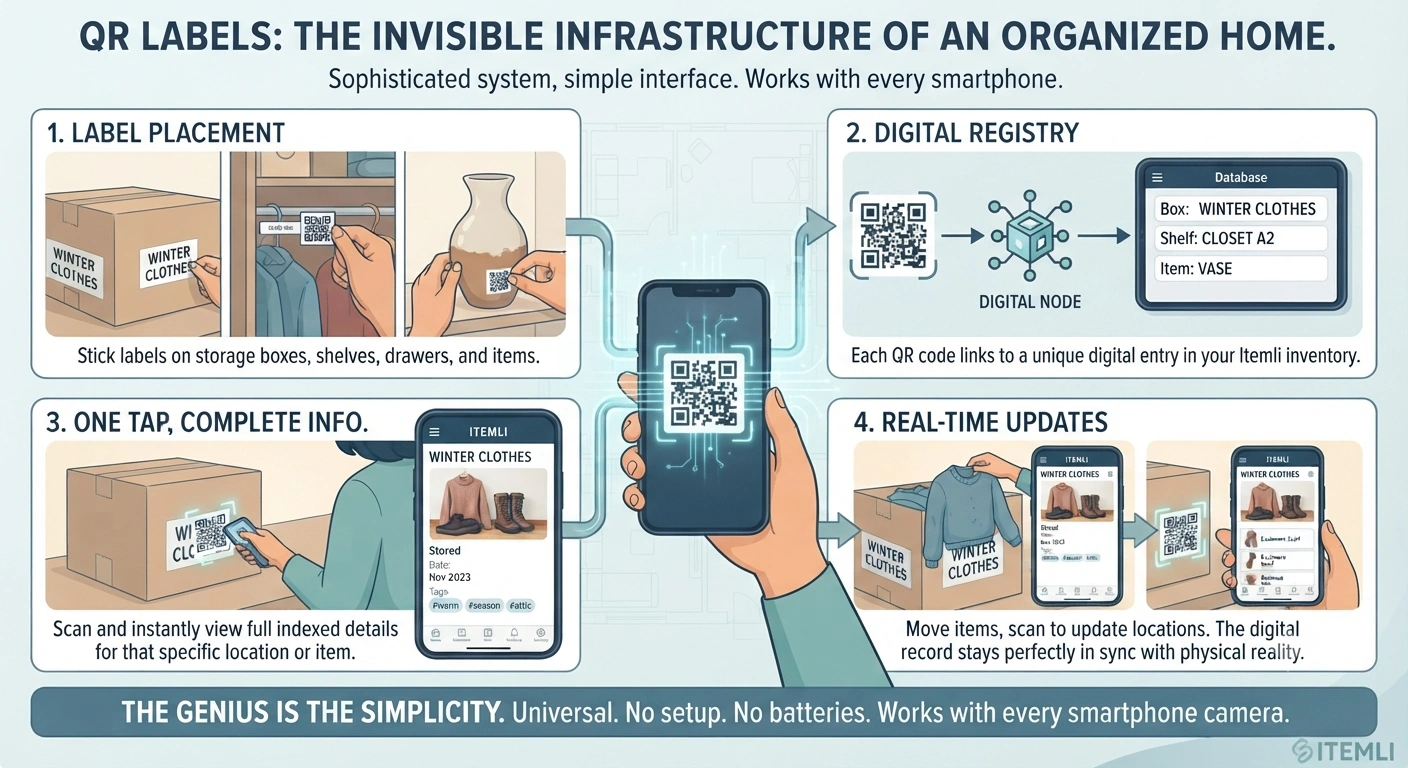
QR labels might seem low-tech, but they're the perfect interface for what's actually a sophisticated system.
Here's how it works:
- Label placement: Stick a QR code label on a storage box, a closet shelf, a drawer, or even individual items.
- Digital registry: Each QR code links to a unique digital node in your inventory system-that box, that shelf, that item.
- One tap, complete information: Scan the QR code with your phone, and instantly see everything indexed to that location: what's inside, condition, when it was stored, and searchable tags.
- Update in real-time: Move items between boxes? Scan the QR code and update where things are. The digital record stays synchronized with physical reality.
The genius is the simplicity: QR codes require no setup, no batteries, no pairing. They work with every smartphone camera. They're universal.
QR Labels Transform Every Container Into a Window
Before QR codes, a storage box was opaque-you had to open it to know what's inside. Labels helped ("Kitchen Stuff"), but they were vague and outdated. After a year, you'd forgotten if that box still contained its original contents.
With QR labels, every box becomes transparent:
- Scan the QR code on "Storage Box #3" and instantly see 47 items: their names, categories, conditions, photos, and the date they were stored.
- Search "camping gear" and see which box it's in, and which boxes contain related equipment.
- Know instantly if something is already in storage before you buy it again.
The box is still opaque. But its contents are now fully visible through a digital layer.
Search by QR: Finding Anything in Seconds
Traditional home organization relies on memory: you remember where you put things, or you systematically search for them. Both fail at scale.
QR-powered homes enable a third approach: indexed search.
The Search Workflow
Imagine you're looking for your camping tent:
- Search your inventory: Open Itemli and search "camping tent".
- Instant location: The app shows you that your tent is in "Storage Box #7" in the garage, stored since June 15th, and is in "Good" condition.
- Scan for confirmation: Walk to the garage, scan the QR code on Box #7, and confirm it's the right box.
- Find it: You've located your tent in seconds instead of spending 20 minutes digging through boxes.
This is radically faster than:
- Searching from memory ("Where did I put that?")
- Physically searching through multiple boxes
- Relying on vague labels that may be outdated
Multiple Search Layers
QR-powered inventory enables multi-dimensional search:
- By item: "Where's my winter coat?" → "Bedroom closet, top shelf"
- By location: "What's in the attic?" → List all 73 items stored there
- By category: "Show me all seasonal items" → See everything tagged seasonal across your entire home
- By condition: "What electronics do I have in working order?" → Find everything active and ready to use
- By date: "What did I store this month?" → Chronological view of recent additions
Each search is powered by the QR-indexed metadata. Your home becomes a searchable database.
When building Itemli, we realized that for a QR-powered home to actually work, the interaction had to be zero-friction. If you're standing in a windowless attic with zero cell signal, waiting for a cloud query to render ruins the entire experience. We engineered Itemli local-first so that scanning a QR code reveals the contents of a box in under half a second, offline or online. The magic of indexed search only works if it's instant.
Moving Workflows: The Transformation of Relocation
Moving is one of the most chaotic experiences anyone encounters: packing hundreds of items into boxes, labeling them vaguely, transporting them, and then spending months trying to find things.
QR-powered moving transforms this entirely.
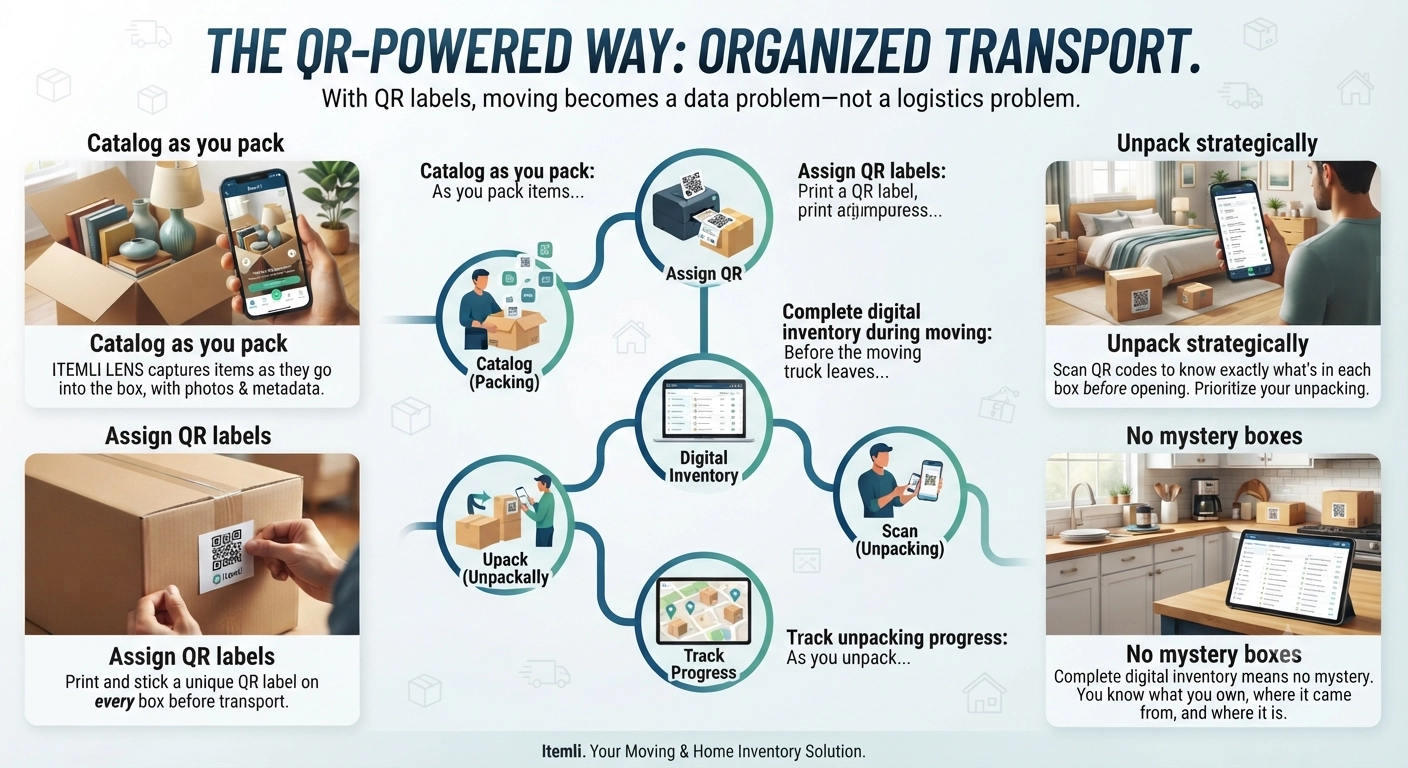
Traditional Moving vs. QR-Indexed Relocation
| Traditional Moving | QR-Indexed Moving |
|---|---|
| Pack items into boxes with vague labels ("Box #7", "Kitchen Stuff") | Catalog as you pack using Itemli Lens-the app records exactly what's going into each box, with photos and metadata |
| Transport boxes and hope labels are accurate | Assign QR labels to each box before transport. Complete digital inventory before the truck leaves |
| Unpack slowly over weeks or months with no clear priority | Unpack strategically-scan QR codes to know contents before opening. Prioritize bedroom, then kitchen, then storage |
| Spend months rediscovering possessions and making duplicate purchases | Track unpacking progress in real-time. Your home's digital map updates as you unpack |
| Mystery boxes sitting in corners for months | No mystery boxes. Every container is cataloged-you know exactly what you own and where it is |
Moving Workflows Solve Four Problems
QR-powered moving tackles the core frustrations:
- Unknown contents: You don't wonder what's in Box #7. Scan it and you see everything inside.
- Duplicate purchases: Before buying replacements, search your inventory. You'll see you already own what you're considering buying.
- Disorganized unpacking: Unpack strategically-bedroom first, then kitchen, then storage-because you know what's in every box.
- Abandoned boxes: No more boxes sitting in corners for months. You have a complete inventory; you can unpack strategically and predictably.
The Ecosystem: QR Labels as Access Points
QR codes are more than just links to inventory data. They're access points into an entire ecosystem:
Shared Homes
Roommates or family members can share access to the inventory. Scan a QR code to see what's in a shared storage box, update item locations, or add notes about missing items.
Temporal Context
QR codes link to timestamped records. When was something stored? How long has it been untouched? This metadata drives decisions: is it time to revisit seasonal items? Should you donate something that's been unused for two years?
Condition Tracking
Link photos to QR codes so anyone scanning the label can see the condition of items. Is that box of electronics in working order or damaged? One scan shows you.
Location Updates
Reorganizing a closet? Moved items to a different shelf? Scan the QR code and update locations. The digital map of your home stays synchronized with physical reality.
Visionary Future: Homes as Searchable Databases
Today's homes are analog spaces with disconnected digital tools. You have a photo library, a calendar, a task list-but no unified index of what you physically own.
QR-powered homes flip this: the physical space becomes indexed, searchable, and interconnected.
The implications are profound:
Radical Transparency
You know what you own. You know where it is. You know its condition. This visibility transforms how you consume: fewer duplicate purchases, more intentional acquisitions, better awareness of what you actually use.
Instant Relocation
Moving or reorganizing becomes predictable and organized instead of chaotic. QR labels ensure you never lose track of your possessions during major life changes.
Seamless Family Coordination
In households with multiple people, QR-indexed inventory solves coordination: "Where's the toolbox?" "Where did you put the holiday decorations?" Scan and you know instantly.
A New Kind of Connected Home
Connected homes focused on appliances. QR-powered homes connect you to what matters: your possessions, your space, and your ability to find and use what you own.
The Bridge to Tomorrow
QR codes might seem anachronistic-a 1990s technology in a world of smart homes and AI. But they're actually the perfect interface between the physical and digital.
They're cheap. They're universal. They don't require batteries or internet. They work with every smartphone. And crucially, they scale: you can label hundreds of items and locations without any infrastructure.
The future of the organized home isn't about adding sensors or smart appliances. It's about creating a searchable index of the physical space through lightweight, universal labels.
QR codes are that bridge. They transform your home from an opaque collection of boxes and shelves into a fully indexed, searchable digital dimension.
Ready to build a QR-powered home? Download Itemli today and start labeling your possessions. Transform your home into a searchable database, one QR code at a time.
Comments
Loading comments…