
July 21, 2026
Why Every Home Needs a 'Second Brain' for Belongings
You own more than you think you do.
Right now, in your home, there are approximately 300,000 items. The average American household contains somewhere between 7,000 and 300,000 objects, depending on how you count. Toys, kitchen gadgets, tools, books, seasonal decor, electronics, clothes—they're all there. But here's the problem: your brain isn't tracking them.
Human memory evolved to remember hunting routes and social hierarchies. It wasn't built to index 500 household items across a dozen storage locations. You don't have a "second brain" for belongings. You have a spreadsheet in your head, and it's full of errors and missing entries.
The Problem With Remembering Stuff
Think about this: you own a power drill. Maybe two. Where's the nearest one right now? Can you name the brand? Do you remember if it's charged? Does it have a full bit set, or is something missing?
Most people can't answer these questions with confidence. Not because they're forgetful, but because human memory doesn't work at scale. It's designed for social recall—remembering faces, names, stories. It's terrible at cataloging physical inventory.
This memory gap creates ripple effects across your entire household:
- Duplicate purchases. You think you need a Phillips-head screwdriver, so you buy one. You already own three. Your brain didn't remember.
- Lost value. Items get stored and forgotten. They deteriorate. You eventually throw them away, turning dollars spent into trash delivered.
- Wasted shopping time. You can't find what you own, so you waste time looking, then just buy a replacement instead.
- Storage anxiety. You know you have things stored somewhere, but you don't know what or where. This creates background stress that doesn't fully leave.
- Bad decisions. When you can't find something, you make emergency purchases. When you can't recall what you own, you make unconscious acquisitions. Poor information = poor choices.
The real cost isn't just money. It's cognitive load. Your brain is running a search for items it can't locate, constantly. That search never resolves. You carry this unfinished task around with you.
What You Actually Need: A Second Brain
The solution isn't trying harder to remember. It's offloading the inventory problem to a system designed for it.
Your home needs a second brain—an external system that never forgets, never gets tired, and never makes mistakes when retrieving information. This system should be:
- Fast to populate. If cataloging is slow, you'll stop after three items. The friction kills adoption.
- Easy to search. What good is an inventory if finding something takes longer than just looking through boxes?
- Intelligent about categorization. It should understand what you're storing without you having to manually tag everything.
- Connected to physical reality. The digital index should map back to physical locations in real time.
This is exactly what Itemli was built to do.
AI Scanning: Eliminate the Friction
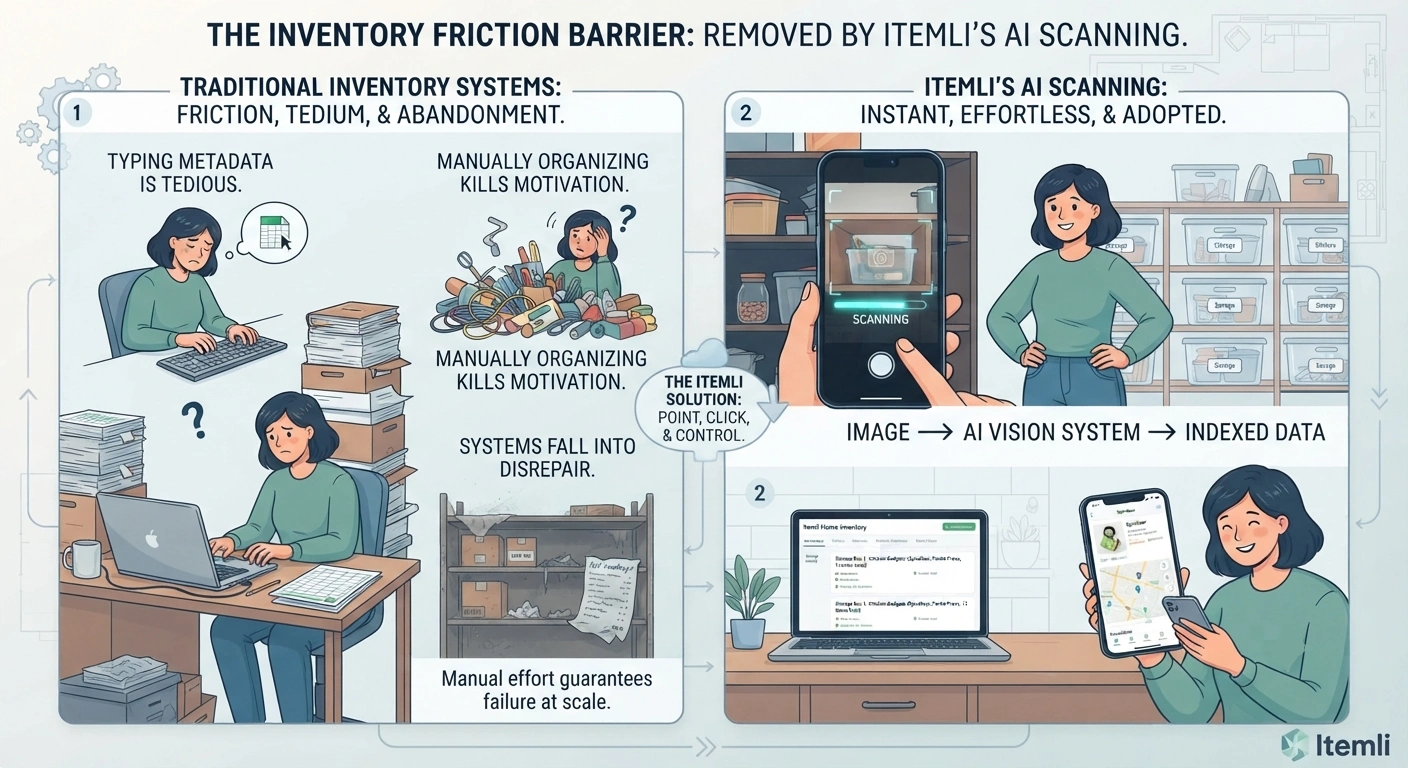
The biggest barrier to inventory systems is friction. Typing metadata is tedious. Manually organizing items kills motivation. Systems that require maintenance inevitably fall into disrepair.
When we were building Itemli, our non-negotiable benchmark was speed. If cataloging a shelf requires manual data entry, the system fails at scale. We engineered our AI vision pipeline so that pointing your camera at a storage box indexes the entire contents in under 30 seconds—eliminating the cognitive friction completely.
Itemli's AI scanning removes this barrier entirely. You don't type. You don't manually categorize. You point your phone at a shelf, a drawer, a storage box—and the AI handles it.
Here's what happens in real time:
- Point your camera at items in storage.
- Itemli's AI vision system analyzes the image instantly.
- Items are identified, categorized, and tagged automatically.
- The entire contents of that storage area are now indexed and searchable.
No typing. No manual data entry. No spreadsheets. The work that would take 30 minutes of careful documentation now takes 30 seconds of pointing and clicking. The friction vanishes, and adoption explodes.
Categories & Tags: Making Chaos Queryable
Once items are captured, they need to be organized in a way that matches how your brain actually searches for things.
You don't think "I need object #4782." You think "Where's my camping gear?" or "Do we have extra batteries?" or "Which box has the holiday lights?"
Itemli's tagging system mirrors this natural search pattern. Every item can have multiple tags:
- Location tags: "Garage," "Basement," "Closet," "Attic"
- Category tags: "Tools," "Seasonal," "Sports," "Electronics"
- Condition tags: "Working," "Needs repair," "Untested"
- Custom tags: Whatever matters to you—"Camping," "Garden," "Kids," "Hobby"
This layered tagging transforms your inventory from a flat list into a structured knowledge system. Search "seasonal + outdoor" and you get holiday decorations, camping gear, and pool supplies. Search "tools + garage" and you get everything related to maintenance and repairs in that location.
Your second brain now understands context. It knows relationships. It can answer complex questions about what you own and where.
QR Codes: Bridging Physical and Digital
Here's where it gets powerful: QR codes connect the physical and digital worlds.
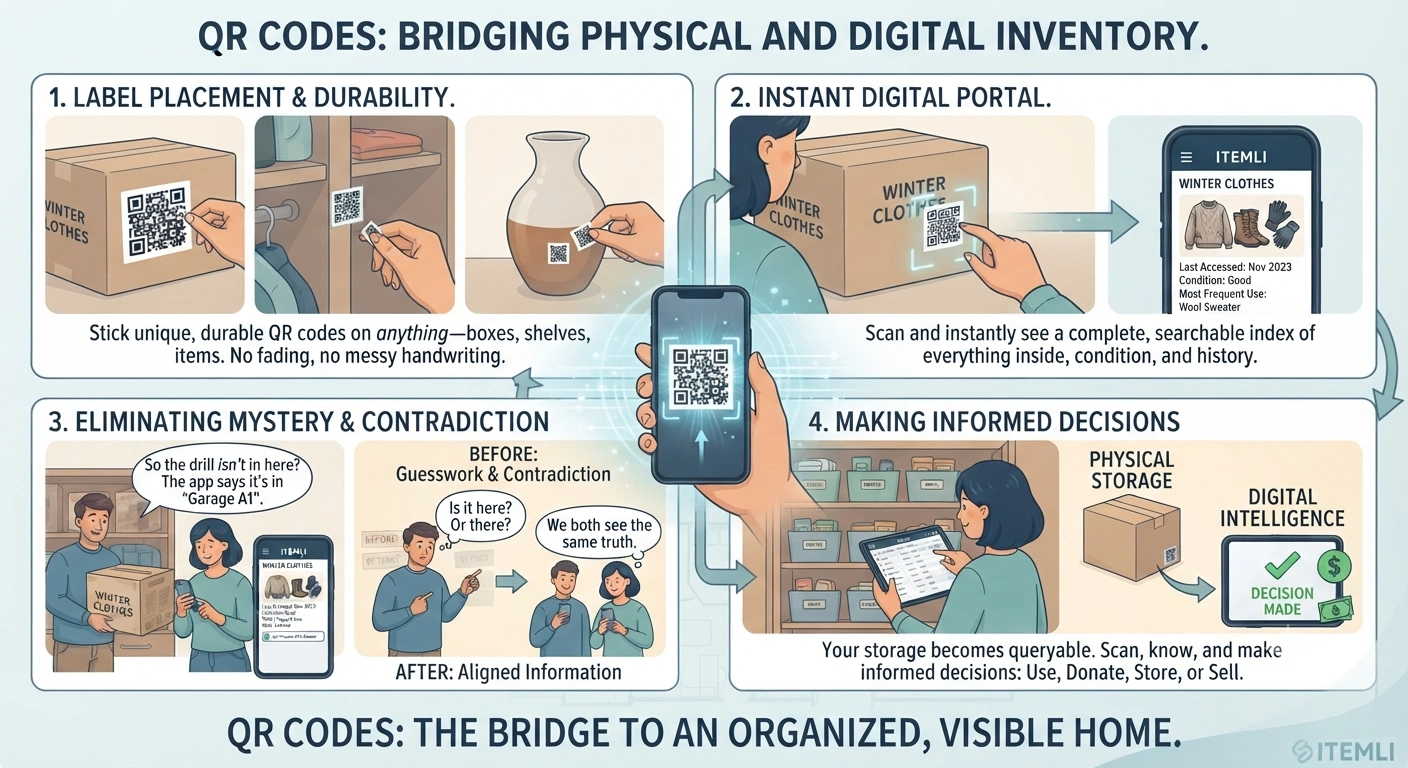
Print a QR code, stick it on a storage box, and suddenly that box becomes an interactive portal. Scan it with your phone, and you see:
- Everything inside that box
- When it was packed
- What condition the contents are in
- Which items you use most frequently
No more opening mystery boxes. No more "Is the drill in this one or the other one?" You scan, you know instantly.
This becomes even more powerful with shared spaces. Multiple people in your home can scan the code and see the exact same information. No more contradicting each other about what's stored where. No more duplicated searches. Everyone has access to the indexed truth.
And because QR codes are durable, they survive where labels fade and handwritten notes become illegible. They're the bridge between the physical reality of your storage and the digital intelligence of your inventory system.
Digital Recall: Memory That Never Fails
This is the payoff.
You're at the hardware store, looking at paint supplies. You need to know: do we already have exterior paint? What color was that deck stain we used last summer? Is the brush situation dire or just bad?
Open Itemli. Search "paint." You get every paint-related item in your inventory: the half-can of deck stain (stored in the garage, opened in July 2023), the two exterior paint cans (unopened, purchased for the side fence project), the acrylic paint set (basement, "hobby supplies"). Date. Location. Condition. Photo.
You don't buy paint you already own. You save $60 and make an informed decision instead of guessing.
This happens everywhere. Before you buy kitchen gadgets, search "kitchen gadgets." Before you replace tools, search "tools." Before you purchase storage solutions, search "storage." You always have information before you make purchasing decisions.
This is what a real second brain does—it gives you perfect recall. Not through effort or discipline, but through a system that remembers so you don't have to.
The Cascading Effects
When you have a second brain for belongings, behavior shifts:
- Intentional purchasing. You know what you own. Buying duplicates becomes a conscious choice, not an accident.
- Better maintenance. You can track condition and storage environment. You catch problems before they become disasters.
- Faster decisions. Decluttering becomes easier. You see what you actually use versus what's just taking up space.
- Reduced cognitive load. Your brain stops running background searches. The stress of "where is it?" disappears.
- Actual organization. When everything is indexed and tagged, actual physical organization becomes easier to maintain. You know where things should go because you know where things actually are.
You're not just managing stuff. You're managing information. And when information is structured, searchable, and accurate—everything gets easier.
The Real Purpose: Making Your Home Work for You
At its core, a second brain for belongings isn't about organization porn or aesthetic storage solutions. It's about something deeper: giving you back the mental space to focus on what actually matters.
Your home has 500+ items. Some you use daily. Some you'll use once a year. Some you've forgotten you own entirely. Without a system to organize that chaos, your brain stays tangled up in uncertainty. "Do we have one of these?" "Where did I put that?" "Should I keep this or does someone else already own it?"
A second brain answers these questions before you ask them.
AI scanning captures items instantly. Tags organize them by how you actually think. QR codes bridge the physical and digital. Digital recall gives you perfect memory. Together, they create a home that works with you instead of against you—a home where you know what you own, where it is, and what condition it's in.
That's not a luxury. That's freedom.
Ready to give your home a second brain? Download Itemli today and transform scattered possessions into an instantly searchable, always-accessible inventory. Your memory just got a major upgrade.
Comments
Loading comments…