
July 11, 2026
Your Home Doesn't Have a Storage Problem, It Has a Data Problem
You have a five-bedroom house. Plenty of square footage. Yet you can't find anything. Your closet is full, but you have nothing to wear. Your garage is packed, but you can't locate a screwdriver. Your pantry looks organized, but you buy milk anyway because you're not sure if you have any.
This is not a storage problem. You don't need a bigger house, a larger closet, or another storage unit.
You have a data problem.
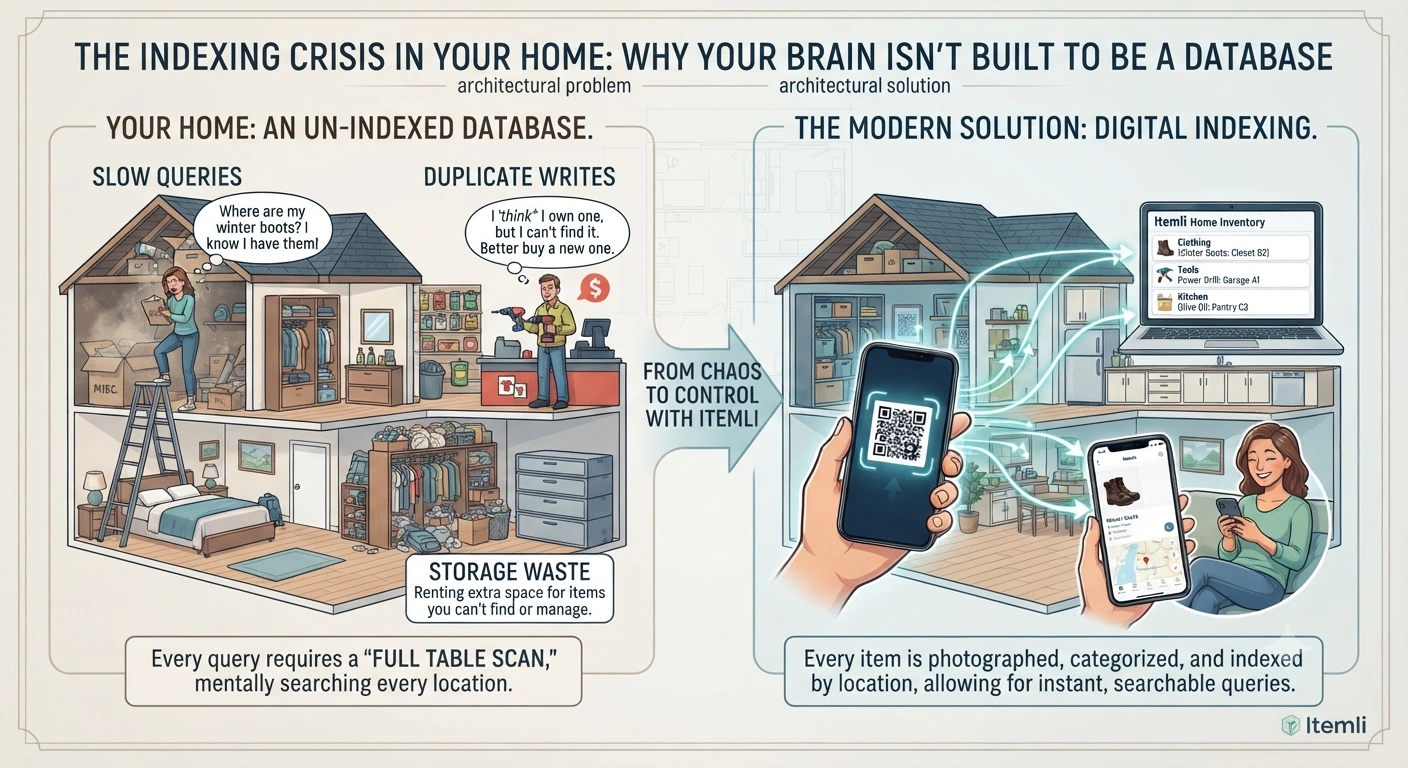
The Indexing Crisis in Your Home
Your home contains hundreds—often thousands—of individual items. Clothing. Tools. Kitchen supplies. Electronics. Seasonal goods. Hobby equipment. Books. Furniture. Each item exists somewhere, physically present, taking up space. But here's the problem:
You have no reliable index.
In the language of data engineering, your home is a massive database with zero indexing. Every query—"Do I own a power drill?" "Where are my winter boots?" "How much olive oil is left?"—requires a full table scan. You have to mentally search through every storage location, every closet, every shelf, every box.
The result? The same inefficiency that would cripple a database:
- Slow queries: Finding what you need takes time and effort
- False negatives: You assume you don't own something because you can't find it
- Duplicate writes: You buy things again because you couldn't query what already exists
- Cache misses: You forget where you stored something, so it might as well not exist
- Storage waste: You rent larger closets and storage units, paying for capacity you can't effectively use
This is not a personal failing. This is an architectural problem. The human brain is not designed to maintain a real-time index of thousands of items across dozens of storage locations. Modern homes create a data volume problem that human memory simply cannot solve.
Why Size Isn't Your Constraint
Consider two households:
Household A: 1,200 square feet. Everything organized, categorized, tagged, and indexed. The occupants know exactly what they own and where it is. When they need something, they find it instantly.
Household B: 4,500 square feet. Plenty of space. But nothing is indexed. Storage is scattered across rooms, closets, boxes, and the garage. When looking for something, they search for 20 minutes, can't find it, and buy a replacement.
Household B has four times the square footage, but Household A is dramatically more organized. Why? Because organization isn't about space—it's about queryability.
The real constraint isn't physical capacity. It's informational clarity. Once your inventory is indexed, sorted, and searchable, the actual square footage becomes almost irrelevant. You can pack items densely because you don't need to visually scan everything to find what you're looking for.
The Database Analogy: Why It Matters
Modern data systems learned this lesson decades ago. An unindexed database table with a million rows is practically unusable—queries take minutes. Add the right indexes, and queries execute in milliseconds.
Your home is the same. You're trying to query an unindexed dataset. Every search is a full table scan. The solution isn't bigger storage—it's better indexing.
Itemli approaches your home as what it actually is: a personal data management system. Instead of relying on fragmented mental maps, visual scanning, or handwritten labels on unmarked boxes, Itemli creates a structured, indexed, searchable database of your possessions.
With proper indexing:
- Search is instant: "Do I own a black winter coat?" Query time: 2 seconds. Answer: Yes, in the bedroom closet, left side.
- Duplicates are visible: When adding items, you can instantly see if you already own that item—preventing redundant purchases before they happen.
- Forgotten items resurface: Items stored away months ago become findable through tags and search, preventing the perceived need to rebuy.
- Storage becomes efficient: You can confidently store items densely because you never have to visually scan to find them.
- Downsizing becomes possible: Without an index, keeping extra space "just in case" feels safe. With an index, you know exactly what you have and can make confident decisions about what storage you actually need.
How Itemli Indexes Your Physical World
1. Structured Input: From Chaos to Schema
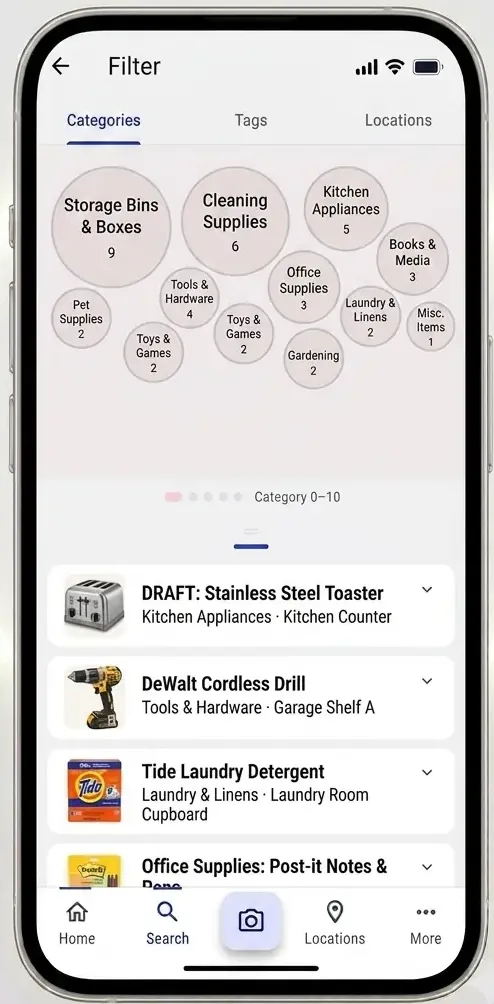
The first step in indexing is structure. Itemli lets you categorize items (Kitchen, Tools, Clothing, Seasonal, Electronics, etc.) and assign them to locations. This creates a schema for your home—a structured way of thinking about how items relate to spaces.
Unlike a shoebox full of receipts or a pile of sticky notes, structured input means your inventory is actually queryable from day one.
2. Tags: Multi-Dimensional Indexing
A single item can have multiple tags: "winter-boots" might be tagged "cold-weather", "footwear", "blue", "size-8", and "storage-closet". This creates multiple indexes on the same item, making it findable from any angle of your mental query.
Someone looking for "where did I put the blue shoes?" can search "blue" and find them instantly—even if they forget the specific category.
3. Search: Query Performance in Your Pocket
Once your inventory is indexed and tagged, search becomes instant. Pull out your phone, type your query, and get an immediate answer. No mental searching. No wandering from room to room. No "I think it's in the garage somewhere."
When we were designing Itemli's database architecture, we realized that for a home inventory app to work, sub-second query speed was non-negotiable. If you're standing in a store aisle wondering if you already own a specific tool, waiting for a slow search loop completely breaks the habit. Instant feedback is what turns data into real-world action.
This solves the core problem: when you're in a store deciding whether to buy something, you can instantly verify ownership before making the purchase.
4. Photos: Visual Indexing
Itemli lets you attach photos to items, adding visual data to your index. Photos of box contents mean you never open an unmarked box hoping it contains what you're looking for. Visual reference prevents the friction of searching.
The Economics of Indexing
Here's the financial reality: most households waste money on storage they can't access efficiently, and more money on duplicate purchases they don't realize they've already made.
Indexing pays for itself through:
- Prevented duplicates: Instant verification before purchase = $500-1000/year saved on average
- Reclaimed storage capacity: Knowing exactly what you own means you stop renting extra space for the "just in case" items you've forgotten about = $100-300/year saved
- Recovered assets: Items you forgot you owned can be used, sold, or donated instead of gathering dust = $200-500/year value reclaimed
The investment in indexing your home—the time to categorize, tag, and photograph your items—returns value within the first year, often within the first few months.
Beyond Money: The Psychological Liberation
The financial benefit is measurable, but the psychological benefit is profound.
When you have an indexed, searchable inventory, you stop living with persistent low-level anxiety about your possessions. You stop wondering if you own something. You stop the mental friction of searching. You stop the decision fatigue of "should I buy this or might I already have one?"
An indexed home is a home where you know what you own. That clarity creates space in your mind for more important things.
The Future Is Indexed, Not Spacious
The modern home is increasingly volumetric. It contains more items, more variety, more complexity. The solution to this isn't building bigger houses—it's applying the same indexing discipline that makes massive datasets manageable to the problem of your personal possessions.
Your storage problem isn't about space. It's about data architecture. Itemli solves this by treating your home as what it actually is: a searchable database of your physical world. Turn chaos into data. Turn data into clarity.
Ready to index your home? Download Itemli on Google Play and transform physical chaos into a queryable dataset.
Comments
Loading comments…