
July 16, 2026
Why Traditional Labeling Systems Fail, And What Replaces Them
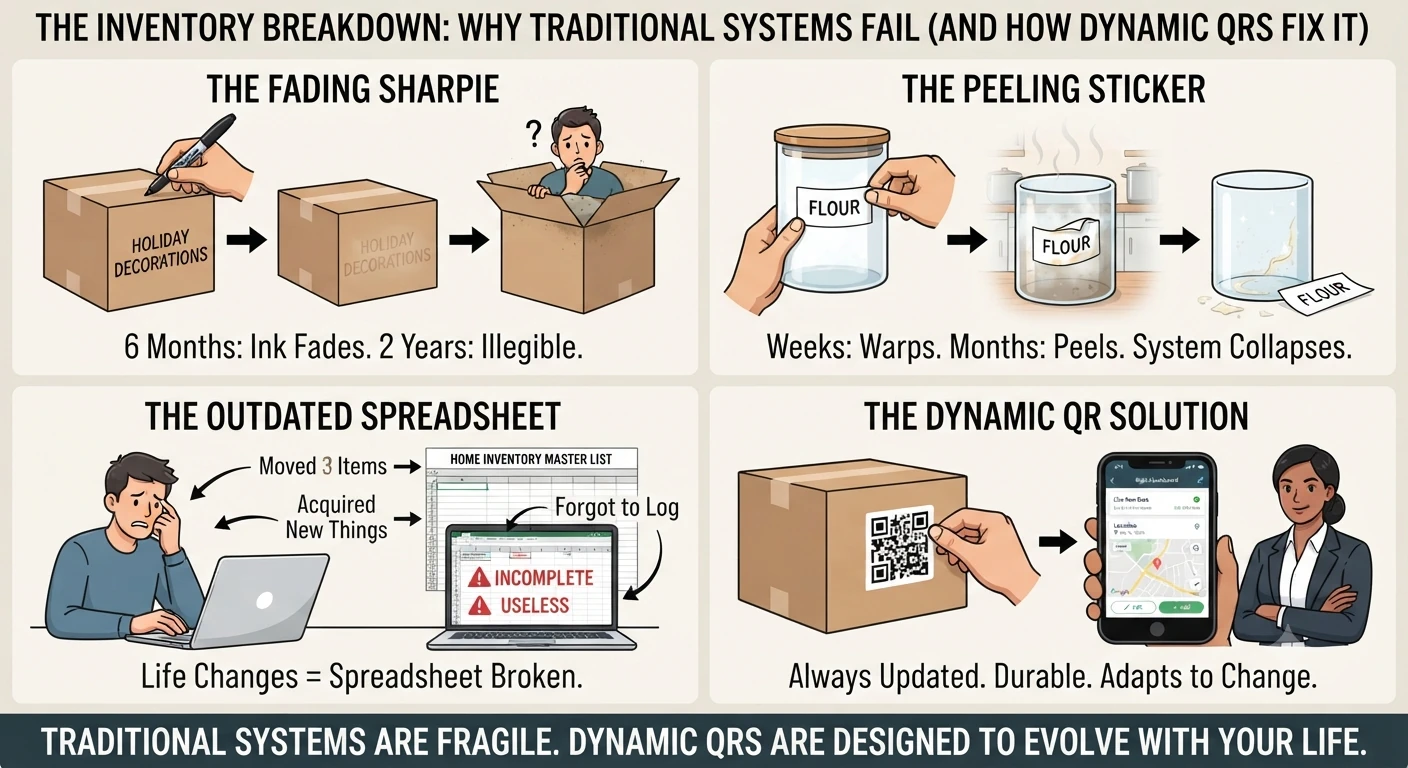
You label a storage box with a Sharpie: "Holiday Decorations." Six months later, the ink has faded in the sunlight. Two years later, you can't read it at all. You open the box wondering what's inside.
You stick a printed label on a kitchen container. Within weeks, humidity warps it. Within months, it's peeling at the edges. You peel it off entirely, and now your carefully organized system falls apart.
You create a spreadsheet to catalog your belongings: every item, every location, every detail. Then life happens. You move three items and never update the spreadsheet. You acquire new things and forget to log them. Within a month, your spreadsheet is incomplete. Within a year, it's useless.
These are the three dominant approaches to home inventory. And they all fail for the same reason: they break down the moment the physical world changes. A Sharpie fades. A sticker peels. A spreadsheet becomes outdated. And when your system breaks, you stop using it entirely.
This is not a technology problem. This is a design problem. And dynamic QR codes solve it in ways that traditional labeling systems never could.
The Fundamental Flaw: Information Decay
Every labeling system humans have ever created for home inventory shares a critical vulnerability: the information it contains is static, while the physical world it describes is constantly changing.
When you label a box "Tools" with a Sharpie, that information lives nowhere but on the physical box. If the label becomes unreadable, the information is gone. If you move the box, there's no automatic way to know where it went. If you add new items to the box, the label remains the same, and accuracy degrades.
This creates a cascade of problems:
- Durability collapse: Labels fade, peel, wear, and tear. The information becomes unreliable and eventually unreadable.
- Accuracy drift: As the physical contents change, the label doesn't update. Over time, the label becomes a lie, and you stop trusting it.
- Searchability failure: When you need to find something, you're limited to whatever information is on the label. If an item fits multiple categories but the label only says one, you can't find it through other search paths.
- System abandonment: When people realize their system is unreliable, they stop using it. The effort to maintain a labeling system exceeds the benefit it provides.
This is why most households don't have a labeling system at all. Not because they don't want one, but because every system they've tried has eventually failed.
Sharpies: The Illusion of Simplicity
Writing labels directly on storage boxes with a permanent marker feels simple and free. You need no special equipment, no software, no spreadsheet—just a Sharpie.
The problem emerges immediately:
- Fading: Sharpie ink fades in sunlight. Labels stored in basements might last years, but labels in garages or attics become illegible within months. UV exposure degrades the ink relentlessly.
- No updates: Once written, the label is fixed. When you move items between boxes, add new items, or change organization systems, the label becomes obsolete. You can't erase Sharpie, so you're stuck with outdated information.
- Single-dimension labeling: You can describe a box as "Tools" or "Garage," but not both. When you can't find something, you can't search for it through alternative categories. You're limited to a single organizing principle, which often doesn't match how you actually think about your items.
- No metadata: A Sharpie label can't tell you when you stored the box, what condition items are in, whether they're still useful, or where exactly the box is located (shelf 3 of the garage? Back corner of the attic?). All that richness is lost.
Most people try Sharpie labels once, watch them fade, and give up. The system breaks before it ever starts working reliably.
Stickers and Printed Labels: Beautiful Until They Fail
Printed labels seem like an upgrade. You can create professional-looking stickers with color, icons, and detail. For the first few months, they look great.
Then the environment takes its toll:
- Humidity ruins them: In kitchens, bathrooms, or basements with moisture, stickers curl, warp, and peel. The adhesive breaks down. Within months, the label is partially detached or completely gone.
- Temperature cycling degrades adhesive: Garages and attics that cycle from hot to cold seasonally cause sticker adhesive to fail. Summer heat softens the glue; winter cold makes it brittle. The sticker lifts at the edges and eventually falls off.
- Physical handling wears them: Every time you pick up a labeled box, friction wears at the label edges. High-traffic storage gets damaged labels from simple use and handling.
- The same accuracy and searchability problems persist: Like Sharpie labels, printed stickers are static. They can't be updated, can't represent multiple dimensions of organization, and don't capture metadata. Once the sticker degrades, you lose all the information.
Printed labels work for aesthetics and for the first year or so. But they're not a permanent solution to inventory management. They're decoration that gradually decays into irrelevance.
Spreadsheets: The Organizational Graveyard
Spreadsheets seem like the logical solution to the physical label problem. Store the information digitally, and it never fades, peels, or decays. It's searchable, detailed, and infinitely flexible.
The problem is that spreadsheets live in a different universe from your actual belongings. Managing two separate systems—the physical world and the spreadsheet—creates an unsustainable maintenance burden:
- Initial data entry is exhausting: Cataloging an entire household requires hours of work: photographing items, measuring, typing descriptions, adding categories and tags. Most people give up before they finish.
- Updates are never made: When you move a box from the garage to the attic, do you update the spreadsheet? When you add items to a storage container, do you log each one? Most people don't. The spreadsheet becomes stale within weeks.
- Drift is inevitable: If 80% of your spreadsheet is accurate and 20% is wrong, you can't trust any of it. You stop using the spreadsheet, reverting to opening boxes and searching manually—which is slower than having no system at all.
- Access is inconvenient: When you're at a store deciding whether to buy something, you need to pull out your phone, unlock it, open the spreadsheet app, search for the item, and wait for it to load. By that time, you've already decided to buy it. The friction is too high.
- The spreadsheet becomes obsolete data: A spreadsheet you created six months ago is a historical record, not a current inventory. Once it falls out of sync with reality, it's worse than useless—it's actively misleading.
Spreadsheet-based inventory systems rarely survive more than a few months. They're theoretically perfect and practically abandoned.
The Three Problems Traditional Labeling Systems Can't Solve
Problem 1: Durability
Labels must survive the physical environment. Sharpies fade under UV light. Stickers peel in humid and temperature-cycling environments. Spreadsheets require you to maintain a separate digital record that stays synchronized with reality—which nobody does.
A labeling system that doesn't last is worse than no system at all, because you invest time in creating it only to watch it fail.
Problem 2: Accuracy
Your home is dynamic. You move things. You add items to containers. You reorganize your storage spaces. A label that describes the contents or location of a box must update when reality changes, or the label becomes a lie.
Sharpies and stickers can't update. Spreadsheets can update, but the overhead of maintaining them causes people to stop using them. Neither approach preserves accuracy over time.
Problem 3: Searchability
When you need to find something, you need to search in multiple ways. "Where are my winter boots?" "Do I have a hammer?" "Which box is in the back corner of the attic?" A label can answer one of these questions, but not all three.
Traditional labels force you to choose a single organizing dimension. You pick "Location" (back of garage) or "Category" (tools) or "Season" (winter), but you can't easily search across all three dimensions simultaneously. This severely limits your ability to find things.
Dynamic QR Codes: The Solution
QR codes solve all three problems by decoupling the physical label from the information it represents.
A QR code is a bridge. The code itself is static—it never changes, never fades, never peels. But it points to information that lives in a dynamic system. The same QR code can represent constantly updated information without requiring the physical label to change.
Durability: The QR Code Itself Is Durable
QR codes are made of simple black and white squares. They're extremely resilient to environmental stress:
- UV resistance: The black and white patterns don't fade under sunlight. A QR code printed on a label in direct sunlight will remain readable for years.
- Environmental tolerance: QR codes work even if partially damaged or obscured. They have error correction built in—you can damage up to 30% of the code and still scan it successfully.
- Multiple substrate options: QR codes can be printed on paper, plastic, wood, or even embossed into materials. They work on any surface in any environment.
Unlike Sharpie ink or sticker adhesive, QR codes have built-in redundancy. They're engineered to survive environmental conditions that destroy traditional labels.
Accuracy: Information Lives Digitally, Not Physically
When you scan a QR code, it directs you to information stored digitally. That information can be updated instantly, from anywhere, at any time. Move a box? Update the location in the app. Add items to a container? Update the contents. Change your organization system? The information reflects the change in real-time.
The physical label doesn't change—the QR code remains the same. But the information it points to is always current. This solves the accuracy drift problem entirely.
You maintain one source of truth: the digital inventory. The physical world reflects that truth, updated as you make changes. There's no separate spreadsheet to maintain, no label to update—just the app and reality in sync.
Searchability: Multi-Dimensional Organization
Once your items are in a digital system, you can search across unlimited dimensions:
- By location: "What's in the attic?"
- By category: "Where are all my tools?"
- By season: "Show me winter decorations."
- By date: "What did I store in the last 3 months?"
- By condition: "Which items are in good condition and could be donated?"
- By custom tags: "Everything I need for the camping trip."
You're not limited to a single organizing principle. A single item can be tagged "tools," "garage," "hardware," and "sharp objects"—and you can find it through any of those search paths. This multi-dimensional organization matches how you naturally think about your possessions.
The Workflow: Durability + Accuracy + Searchability
Here's how dynamic QR codes create a superior inventory system:
- You label a storage box with a QR code sticker. The sticker is durable and permanent. The QR code never fades or peels because it's engineered to survive environmental stress.
- You scan the QR code with your phone. It opens the digital record for that container in your inventory app.
- You see the current contents, location, and all metadata. The information is always up-to-date because it's stored digitally, not physically.
- When you move the box or add items, you update the app. The QR code remains unchanged. The information it points to is instantly refreshed.
- When you need to find something, you search the app. You can search by location, category, tags, date, condition—any dimension that matters. You'll either find it instantly or know definitively that you don't own it.
This is fundamentally different from traditional labeling. The physical label is durable and permanent. The information is dynamic and always accurate. You get all the benefits of a digital system without the burden of maintaining a separate spreadsheet.
Beyond QR Codes: Integration With Itemli
Itemli takes dynamic QR codes one step further by automating the entire workflow:
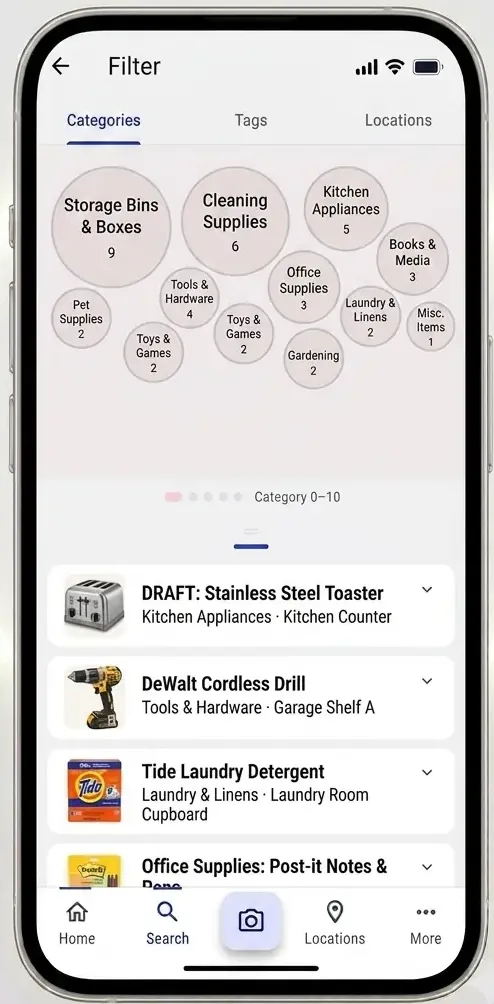
- Scan to log items: Instead of typing item descriptions, you can use Itemli Lens to photograph items and AI automatically catalogs them into your inventory. You get the speed of scanning with the intelligence of AI.
- QR code integration: Print Itemli-generated QR codes and apply them to your storage containers. Every QR code is automatically tied to your inventory, ready to scan.
- Real-time sync: Your inventory is stored locally on your phone but synced across devices. Changes you make update everywhere instantly.
- Multi-dimensional search: Find items by location, category, tags, date added, condition—and combinations of all of these. Your entire home becomes searchable.
The result is a home inventory system that is durable, accurate, and searchable—addressing every failure mode of traditional labeling systems.
The Comparison: Sharpies vs Stickers vs Spreadsheets vs QR Codes
| System | Durability | Accuracy | Searchability | Maintenance |
|---|---|---|---|---|
| Sharpie Labels | ❌ Fades quickly | ❌ Can't update | ❌ Single dimension | 🟡 Low effort, abandoned quickly |
| Printed Stickers | 🟡 Fails within 1-2 years | ❌ Can't update | ❌ Single dimension | 🟡 Moderate effort, eventually abandoned |
| Spreadsheets | ✅ Never decays | ❌ Requires manual updates | ✅ Unlimited dimensions | ❌ High maintenance burden |
| Dynamic QR Codes | ✅ Built for durability | ✅ Always current | ✅ Unlimited dimensions | ✅ Low overhead, sustainable |
QR codes are the only approach that solves all four requirements: durability, accuracy, searchability, and sustainable maintenance. They combine the best of physical labels and digital systems without the drawbacks of either.
The Future of Home Organization
Traditional labeling systems failed because they tried to solve a digital problem with physical tools. Once you understand that home organization is fundamentally a data problem—indexing and searching what you own—you realize that the solution must be digital.
But digital doesn't mean spreadsheets or apps that exist separate from your physical home. Dynamic QR codes create a bridge: a durable, permanent physical label that points to an always-current digital record. This is the only labeling system that survives over time.
Your Sharpies will fade. Your stickers will peel. Your spreadsheets will rot and become obsolete. But a QR code will remain readable for years, pointing to information that's always accurate and searchable in every dimension that matters.
This is what the future of home organization looks like: durable labels, accurate data, infinite searchability. Not a choice between physical and digital—but both, working together seamlessly.
Ready to replace your failing labels with a system that actually works? Download Itemli on Google Play and start building an inventory system that's durable, accurate, and searchable for years to come.
Comments
Loading comments…